Last Watch Before Dawn: Volume 1, Page 3

This page kicked my butt and adding text in Photoshop is not exactly a nightmare, but more like one of those frustrating dreams where you’re trying to do a simple task and your brain keeps generating obstacles.

I’m still working out the art style and used some fancy brushes for this one. Let me know what you think.

Below the cut to save your RAM:

Continue reading “Last Watch Before Dawn: Volume 1, Page 3”

Last Watch Before Dawn: Volume 1, Page 2

I think I’ve been threatening you with this page for like two weeks now. Maybe three.

Below the cut to spare your RAM:

Continue reading “Last Watch Before Dawn: Volume 1, Page 2”

Last Watch Before Dawn: Volume 1, Page 1

So it begins!

To avoid gumming up your scrolling with a huge image, I’ll put it below the cut:

Continue reading “Last Watch Before Dawn: Volume 1, Page 1”

The Well Below the Valley, Episode 7: The Souls of the Heathens

A bleak, leafless tree against a sepia-toned sky. Text reads: Space Whales Press presents The Well Below the Valley, an audio drama

Table of Contents

Dramatis Personae
(in order of appearance)

Eloise “ELLIE” Westmont, probably the best investigator of the group. Female, mid 20s, posh English accent.

Detective Chief Inspector ISKANDAR Meshkia, lender of a small degree of official authority to the operation. Male, late 30s, strong Turkish accent.

KURT Cross, actor, veteran, and car-haver. Male, early 30s, New York accent.

The FIRST CULTIST at the scene, Milton’s enforcer. Male, any age, London accent.

The SECOND CULTIST at the scene, perhaps one with more focus on the magic and mysteries. Male, any age, London accent. 

Dr. ERNEST Wilde, a logical person about to be plunged into an illogical world. Male, early 30s, Northern English accent.

Sebastian MILTON, custodian of arcane lore and hidden mysteries. Male, mid 50s, London accent.

JASMINE Indrani, the late professor’s missing assistant. Female, late 20s, could have a British or Indian Accented English accent. 

Henry CARLTON, Ernest’s longtime friend and practical grounding influence. Male, early 30s, London accent.

EMILIA Niyazova, one of the only people in this Godforsaken city who can make a good cup of Turkish coffee. Female, early 20s, slight Russian (actually Kazakh) accent.

NIGEL Blackthorne, believer in magic. Male, early 30s, posh British accent.

Scene 1: Ext. South Bank market – Night

Continue reading “The Well Below the Valley, Episode 7: The Souls of the Heathens”

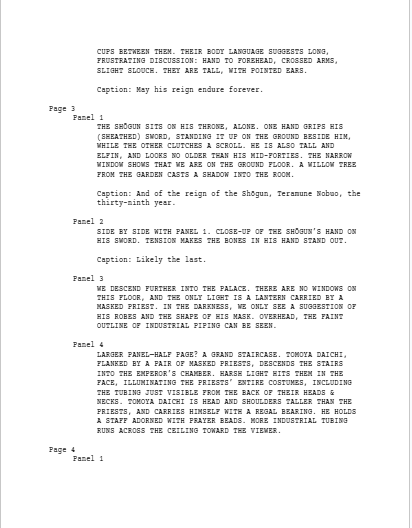
Chrysanthemum Dawn: comic script preview

Here’s what I’ve been working on in between episodes of The Well Below the Valley. (The text is recreated below, for screen readers and/or people who don’t want to squint.)

Right now, I’m still learning how this process is going to work. For a traditionally published comic, the writer would hand a script like this to the lead artist(s), but since I am a team of one, I just need to have enough information that future me can remember what I was thinking. I also haven’t started storyboarding yet, so I’m guessing on layout and panel styles. Pacing in sequential art is a complex process of guiding the reader’s eye around the page, and it’s something I’m going to have to learn by doing.

Thanks for coming along on this journey with me! I hope this little snapshot intrigues you.

Text is recreated below the cut:

Continue reading “Chrysanthemum Dawn: comic script preview”

The Well Below the Valley, Episode 4: Lost Daughters

A bleak, leafless tree against a sepia-toned sky. Text reads: Space Whales Press presents The Well Below the Valley, an audio drama

Table of Contents

Dramatis Personae
(in order of appearance)

Professor Josef DIETRICH, colleague of the murder victim. Male, mid 40s, German accent. 

Detective Chief Inspector ISKANDAR Meshkia, a man who has held many titles in his life but none more important than “Baba.” Male, late 30s, strong Turkish accent.

Dr. ERNEST Wilde, botanist and puzzle enthusiast. Male, early 30s, Northern English accent.

Eloise “ELLIE” Westmont, a private investigator of many skills. Female, mid 20s, posh English accent.

FREYDÍS Emundrsdóttir, the late professor’s next of kin. Female, late 20s, slight Icelandic accent.

The memory of MUSTAFA Effendi, Iskandar’s childhood friend, now deceased. Male, early 30s, could speak with a Turkish or English accent.

The memory of HALIME, a princess in her father’s eyes, now deceased. Female, about five years old, could speak with a Turkish or English accent.

Mrs. JUDITH Rosenfeld, who was very proud the day she installed a telephone in her building. Female, late 40s, slight Yiddish accent.

EMILIA Niyazova, flapper and velocipedist. Female, early 20s, slight Russian (actually Kazakh) accent.

Constable John TAYLOR, just doing his job. Male, early 20s, London accent.

Constable ANTONY St. John, fencing enthusiast and important alibi. Male, early 30s, London (specifically Estuary) accent.

Chief Superintendent Winston PEMBROKE, Sr., a representative of the system. Male, early 60s, English accent with audible mustache.

Scene 1: Int. Oxford Faculty of History – Day

Continue reading “The Well Below the Valley, Episode 4: Lost Daughters”

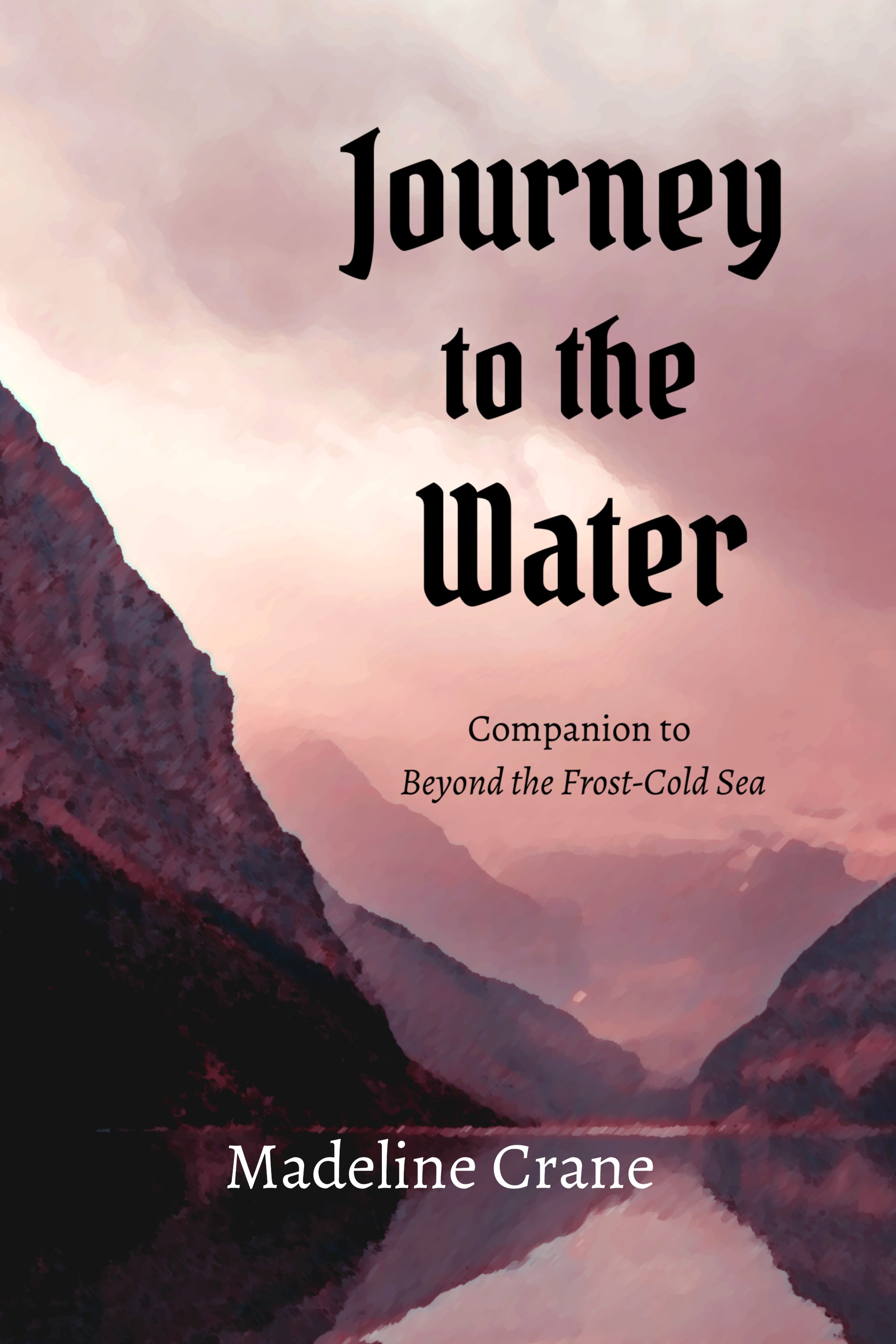
Journey to the Water is now out in the world!

Today’s the day! Thank you so much for your support and patience. I hope you enjoy the book!

Read the first chapter!

After a thousand years of tyranny, the holy city of Phyreios is free. Its freedom comes at the cost of many lives, among them the healer Khalim, beloved by many but none more than Eske of the Bear Clan, the warrior from the North. Now Eske is alone, and a new king, a god in Khalim’s guise, presides over the city’s survivors. Of Khalim himself, nothing remains but a memory and a riddle: in order to follow him, one must travel beyond the edge of the world, breach the gate of bone on a day without a sun, and cross the river of memory, deeper than the sea.

Armed with his strength, his wits, and a good tale or two, Eske sets off across the known world, encountering priests of forgotten gods, great beasts of ancient times, and sorcerers of uncanny power. He will perform any task, make any sacrifice, for the chance to see his beloved again.

Inspired by Robert E. Howard’s CONAN THE BARBARIAN and Ursula LeGuin’s EARTHSEA novels, JOURNEY TO THE WATER concludes the epic story begun in BEYOND THE FROST-COLD SEA.

Amazon (paperback & ebook)

Barnes & Noble (paperback & ebook)

Bookshop.org (coming soon!)

Thriftbooks (paperback only, usually discounted)

Kobo (ebook only)

Apple Books (ebook only)

If you don’t see your favorite place to buy books, let me know! I’m on most platforms and am working on getting my books into brick-and-mortar stores.

And when you finish it, be sure to leave a review! It’s the best way to help new readers find my work.

Tomorrow!

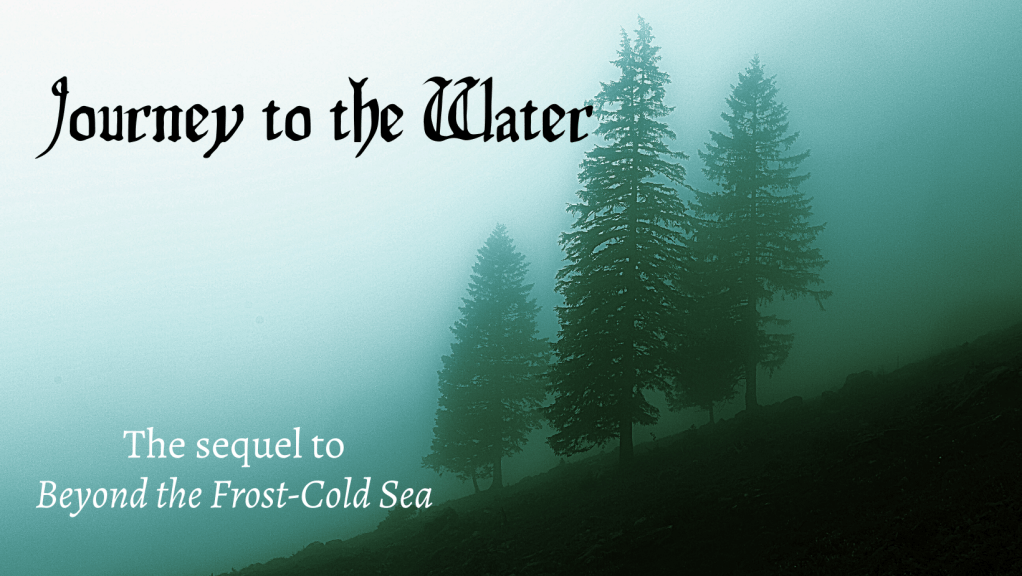
Text in front of a foggy hillside with trees. I had walked the tundra and the steppe. I had crossed the mountains of the North, starving, mad, and alone. This would be no different. Journey to the Water: available tomorrow!

Eske’s long travails are finally coming to an end on Friday, December 20. I am so excited to finally get this book into your hands! Thank you ever so much for your support and patience.


After a thousand years of tyranny, the holy city of Phyreios is free. Its freedom comes at the cost of many lives, among them the healer Khalim, beloved by many but none more than Eske of the Bear Clan, the warrior from the North. Now Eske is alone, and a new king, a god in Khalim’s guise, presides over the city’s survivors. Of Khalim himself, nothing remains but a memory and a riddle: in order to follow him, one must travel beyond the edge of the world, breach the gate of bone on a day without a sun, and cross the river of memory, deeper than the sea.

Armed with his strength, his wits, and a good tale or two, Eske sets off across the known world, encountering priests of forgotten gods, great beasts of ancient times, and sorcerers of uncanny power. He will perform any task, make any sacrifice, for the chance to see his beloved again.

Inspired by Robert E. Howard’s CONAN THE BARBARIAN and Ursula LeGuin’s EARTHSEA novels, JOURNEY TO THE WATER concludes the epic story begun in BEYOND THE FROST-COLD SEA.


Get the paperback of Beyond the Frost-Cold Sea for 20% off through December 23 (Monday)

Read the first chapter of Journey to the Water

Journey to the Water Chapter I (Free Preview)

Journey to the Water: Companion to Beyond the Frost-Cold Sea

Prologue: The Citadel

Here stood the white city, its columns of pale marble bathed fiery red in perpetual twilight and its flagstone streets bare of dust, silent as a grave. He had been here for an age, he thought, because he could not remember where he had come from, and the sun did not move from the scarlet horizon, nor did the small, twisted trees confined to marble stands grow taller or shed their leaves. He needed neither to eat nor sleep, so he wandered alone in the endless, unchanging evening, waiting for the last of his memories to leave him at last.

He had already forgotten how he had come to be here, where he might have been before, and why his heart ached as he turned each corner to find it empty, the windows of the houses shuttered and the doors shut. If he could forget the ache, too, he might have been content here.

The streets lay on an orderly grid, north to south and east to the setting sun that never set. At the center, the temple stood watch over the city, its windows of many-colored glass glittering. He had tried the door a hundred or a thousand times, but it was far too heavy for him to move. Standing under the arch, one brown hand against the white stone, he thought he could sense watchful eyes gazing down at him. There had been another temple like this one, with its doors open to the desert air, and within had stood towering effigies of inhuman beauty whose stone eyes looked upon the people below without seeing. A shiver of fear and awe traveled down his back, and he took his hand from the door and placed it flat against his chest, a gesture that might have once held meaning, but no longer did.

He turned away from the temple. A gentle wind stirred the confined gardens of the central square, setting the trees to whispering. Under his bare feet, the steps were cold, untouched by the distant sun. They should be warm, he thought. The wind should smell of dust and iron, and I shouldn’t be alone.

This was another memory, however brief and unclear, that he was certain to lose. No sand troubled the streets here, and no colored banners flew aloft, and the city was empty of everyone except for him.

He crossed the square and walked west into the faded light between the flat, rectangular faces of shuttered shop fronts and unoccupied houses. Between them, rows of tiny flowers, blue as a forgotten summer sky, curled their petals half-closed in readiness for a night that never came.

These flowers were the first to disappear as he went farther from the temple, followed by the doors and windows, and then the blank faces of the buildings themselves. The flagstones underfoot grew smooth and indistinct. Another step, and all was white fog, cold and intangible.

He held out one hand, curling his fingers around nothing. This had happened last time, and the time before—he had kept walking, then, chasing the indistinct memory of clouds of mist rolling over vast, green fields flooded with clear water. Surely, he had thought, that place was on the other side of the wall of fog.

He had walked and walked, and found himself some time later back in the citadel, standing before the temple’s indifferent doors. Still, he pressed forward again, clinging to the small, forlorn hope that this time might be different, that there would be people on the other side, and a sky that changed with the hours and gave sun and rain to the earth below; that there was an end to this sterile, dead place and its cold marble walls.

If only he could remember where he had come from, or by which way he had entered the citadel. Fear rose like bile in his throat, and he swallowed it down, closing his eyes and reaching out his hands as he pushed forward through the expanse of white.

The edge of a marble flagstone caught his foot, and he stumbled and fell. Pain lanced through the palms of his hands. He raised his head, and the temple towered above, its columns like faceless sentries beneath their red-stained arches. He was back in the center square, just as he had expected.

He pushed himself to his knees and buried his face in both hands. Despair would not lead him to freedom, nor would it devour the last shreds of memory that spurred him to seek a way out, but it was unrelenting. If he allowed it, it would carry him by tiny crack and finger-hold, of which there were very few but just enough, to the top of the temple and off its domed roof to the steps beneath, but he would refuse it as long as he was able. Though he could not remember, he had the firm conviction that someone, somewhere, would mourn for him.

Lifting his head, he took a breath, the first in some time. A fall from the top of the temple might not end his thin, lonely imitation of life, then. The relief was fleeting, replaced as soon as it had come by a cold, creeping horror. Not even death would remove him from this place.

A flutter of movement caught his eye, and he looked up to the lowest archway over the temple stairs. An owl, its feathers shimmering in the low sunlight, alighted on the marble peak, shaking out its wings. Its face was round and white as a full moon.

It was the first living thing that he had seen since he came to the citadel an hour or an eternity ago. He stood, one foot at a time so as not to startle it, and crossed the square to stand beneath the arch. The owl bent its head to preen beneath its wing.

“Hello there,” he said, and his voice was that of a stranger, and hoarse from lack of use. He had not spoken to anyone for as long as his troubled memory could recall.

The owl turned its moon face to him, tilting its head to one side and then the other. He stood still, not daring even to breathe, lest he frighten it away.

He had always been good with animals, hadn’t he? He remembered an ox’s soft muzzle under his hand, the weight of its huge head pushing against him. Despite its size, he recalled no fear.

The owl opened its hooked beak and spoke.

“Hello,” it said. “Is that your face that you’re wearing?”

Startled, he retreated by a step. It was an unusual thing, surely, for an owl to speak with the voice of a man. Bringing a hand to his face, he said, “I think so. Whose would it be?”

The owl ruffled its feathers in the avian imitation of a shrug. “I seem to recall seeing it before, that’s all. It’s rather impolite to steal another’s face, you know, though you don’t look like you’re strong enough for that. Who are you?”

“I—” He opened his mouth to speak, but no name came forth, neither his nor that of some other man. He could not have told the difference had one come to mind. “I don’t remember,” he confessed, and the speaking of it summoned back the fear and despair he had tried so hard to banish. Again he placed his hand against his chest, and again it brought him no comfort.

“A pity,” said the owl, “but perhaps it’s for the best. Rest well, little one.” It spread its obsidian wings, blotting out the dim red sun and reaching the full span of the arch, and moved to take flight.

“Wait!” he cried. “Who are you? By which way did you come? I must get out. I’ll go mad.”

The owl folded its wings again, blinking its jeweled eyes in annoyance. “So many questions. You’d be wiser to stay here, little one, where you’re safe.”

It must have come from somewhere outside the citadel. Despite the poor state of his memory, he was certain he had never seen the owl before. “I cannot stay,” he said again. “Only show me the way out, and I’ll not trouble you again.”

“You don’t even know your own name,” the owl scoffed. “How do you expect to go anywhere if you don’t know who you are?”

“I don’t understand,” he said.

“What is your name, little one?”

He closed his eyes, blotting out the shadow of the owl against the red sun. Images, as indistinct as a dream upon waking, flitted through his unsteady mind: a mountain the color of rust towering over a city not unlike this one, crowned in a wreath of clouds, and the same mountain lying low and hollow as smoke rose from the ruins.

“I can’t remember,” he said.

The owl leaned down, stretching its feathered neck, and fixed him with an unblinking, onyx stare. “Your name.”

A name—surely he’d had one, once, and he could hear it now, called out across the field at sunset, summoning him home, or rising above the shouts of a crowd amidst a cloud of disturbed dust, obscuring all their faces, or whispered in the dark, soft and fervent as a prayer.

“Khalim,” he said, and this time he recognized the voice in which he spoke. “My name is Khalim.”

“Ah,” said the owl. “Someone remembers you.”


Journey to the Water releases December 20!

Journey to the Water Chapter LXVIII: The New Phyreios

Journey to the Water cover image: three evergreen trees stand on a hillside, shrouded in bluish fog. Subtitle reads: the sequel to Beyond the Frost-Cold Sea.

Table of Contents

Here stood Phyreios, the holy city, much diminished: the great Iron Mountain was no more than a gentle hill, lower than the spires of the newly rebuilt temple complex. No paths etched the rust-colored earth, and the black maw of the mine remained closed, perhaps never to be opened again. The towering forge had not yet been restored, and the place where it had once loomed over the industrial quarter was only empty sky. 

In my memory, Phyreios was a ruin, its pale stone scarred by fire and cast down to lie in broken piles of rubble. I had not seen it for more than ten years. How strange it was to behold the walls rebuilt, the great gate remade and standing open to let in a procession of travelers and merchants, the streets cleared of debris and paved smooth and even. Guards in white tabards stood smiling in the sun, greeting each of the passers-by with a nod. Overhead, a new aqueduct came down from the mountain, water sparkling like silver and babbling like the laughter of children. There were children, too, clean and well-fed, running through the market square, asking the shopkeepers not for money but for sweets. The dark, reeking slums outside the walls were gone. Colorful tents spread out like bright insects from the gate, and fresh water flowed easily from a pump beside the wall, where the women of the caravans gathered with their baskets and jugs. The passage of the great worm was like the dream of a dream, forgotten upon waking. 

But I, who had seen the city fall, knew where to look for its scars. The stones that made the arch over the gate had scorch marks on the underside, and the columns holding the aqueduct aloft were rough with chips and scratches. As I passed through the gate and wandered away from the market, the city fell quiet, and empty houses with dark windows sat silently on either side of the thoroughfare. Even now, with travelers coming and going each day, not enough people lived in the city to fill these rebuilt dwellings. 

Continue reading “Journey to the Water Chapter LXVIII: The New Phyreios”