I’ve finished my reread of Journey to the Water! Next step to get it into shape is a new outline, and then the Great Rewrite begins. In the meantime, I thought I’d share a little bit about my editing process, in the hopes that it will be helpful, of interest, or both. I’ve mentioned a few of the steps of my process before, but it will be good to have it all in one place.
Here are three things about me:
- I cannot afford to pay a good editor at the rates that they deserve.
- I have a Master’s degree in English literature. (Points 1 and 2 may be related.)
- I do my own editing, but I always, always have at least one other person whose taste and advice I trust read through my manuscripts before they go to publication.
In order to edit my own work, I need to first distance myself from it.
(This got long, so the rest is behind the cut:)
I get it! Your book is your baby! You had a brilliant idea, or several, and you’ve spent so much time and effort on bringing it into existence! But now you’ve got to treat it like your job. Or like your fourth or fifth paper on Hamlet that you didn’t want to write but you’ve got to get a good grade on, and you’re pretty sure the professor doesn’t like you much.
At the same time, however, you need to be able to experience the text as a reader does. When you’re selling a book, you’re not just selling some ink on paper/bits on a screen, you’re selling an experience. That experience might be edge-of-their-seat excitement, creeping horror, falling in love along with your characters, exploring alien worlds, or some combination of all of it! Errors in spelling/grammar/punctuation distract from that experience. So does using the same words over and over again. So do more complex flaws, such as in characterization, pacing, or plot. You might intend to give your readers a sweet love story, but what’s actually on the page is a terrifying tale of a stalker pursuing their victim. (An extreme example, but I’m sure you can come up with a book or film that fits the bill.)
For instance, I wanted readers of The Book of the New Moon Door to feel just as lost as Berend and Isabel were in the face of the world falling apart. I didn’t want to spend a lot of time explaining things, because Berend and Isabel didn’t have time for that. (A lot of my editing process involved cutting sections of dialogue in which characters get each other up to speed on what they know.) A different writer might have given the reader more knowledge than the characters had (this is called dramatic irony, if you didn’t already know), so that the tension came from watching Berend and Isabel blunder into danger that the reader knew was coming but the characters did not, but that wasn’t the experience that I had in mind.
Your first draft, as people much smarter than me have said, is for making the story exist. The second is for making it work. (Further drafts are to refine and perfect it.) In order to figure out what makes it work, you need some emotional and mental distance from it.
So, my first step is always to put the finished first draft aside for a while. I’d say at least a month, but people will tell you different things. During that time, I try to interact with it as little as possible: I don’t look at it, don’t think about it, and do my best to forget all the thoughts I had while I was writing it. This is important, because we read with our brains more than our eyes. If you still remember what you meant to say, your brain will automatically correct it while you’re reading, and you won’t realize that what you actually wrote doesn’t make any sense. You need to approach the text as a reader would–someone who doesn’t know the correct spelling of your main character’s name, or that your villain comes from Fantasylandia and not Fantasytopia, or that the love interest is attractive and cool.
When the story has become a vague, fond memory, I print out the document. I prefer the hard copy, because it’s easier on my eyes and I can write directly on it in as many colors as I need (this can be done in a word processor, but it’s too many steps for me). The change in format is essential–you need to not be staring at the same thing you stared at for weeks/months/years on end while you were writing. If you prefer to work digitally, change the font, font size, page color, program, and/or the device you’re reading it on. It needs to look different. This will help you catch errors that you missed while writing. Again, we read with our brains, and our brains know what we meant to say. Changing the appearance of the document, as dramatically as possible, helps trick our brains into noticing errors we would otherwise overlook.
Then, I make myself a page of notes. Here’s the one I made for Beyond the Frost-Cold Sea.
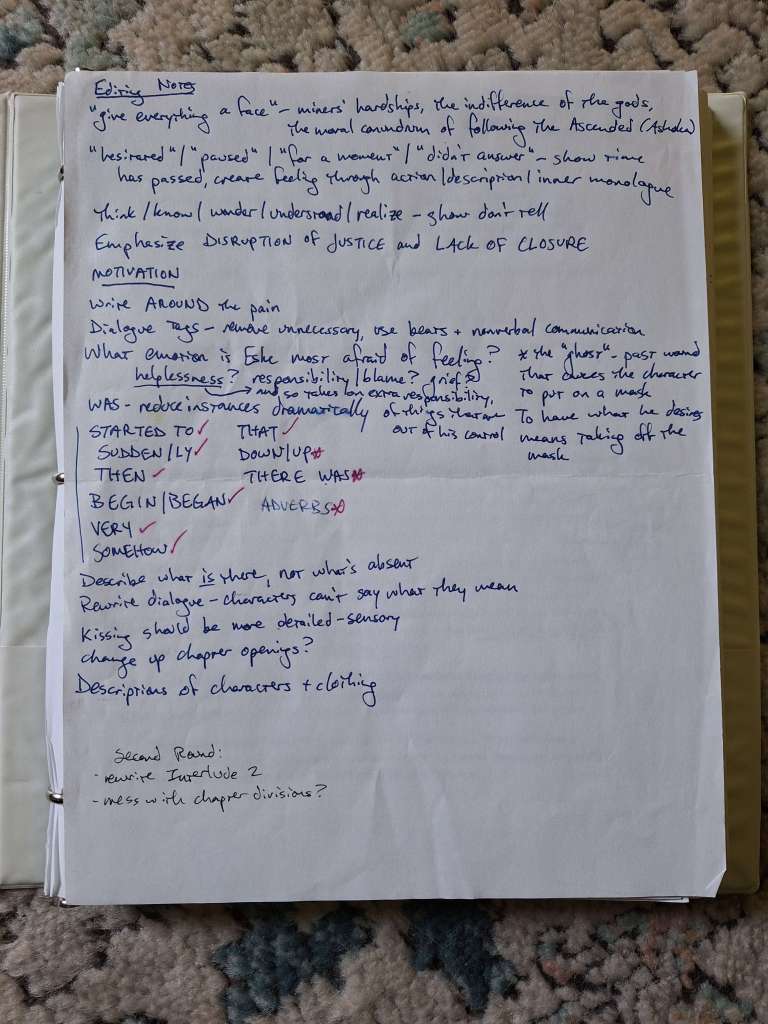
These were all the things I wanted to keep an eye out for while I reread the draft. You’ll notice it includes both notes on character motivation and theme as well as lists of words I wanted to avoid. You might prefer doing these as two (or more!) separate rereads, or saving the more nitpicky bits (word choice, punctuation, repetition) for the reread of your next draft. I prefer to just try to get everything all at once, because if I don’t write something down I’ll forget it pretty much instantly. I’ll do a word search or find-and-replace in the next draft to get an idea of how often I’m still using my favorite repetitive words and phrases.
It helps that I already know some of my poor writing habits and can make notes for myself to look out for them. I tend to over-rely on “to be” verbs (is/was/had been), and often these can be exchanged for more precise verbs or less repetitive turns of phrase; Beyond the Frost-Cold Sea had the word “great” describing everything (the great serpent’s great lidless eye, etc.), and while it fit the tone, too many “greats” tends to grate (har har); phrases like “for a moment” or “he/she/they said nothing” are sort of the training wheels I use to get through the first draft, and it’s almost always better to describe time passing through character actions and thoughts, so the reader feels it instead of just being told that a moment passed. If you don’t know these sorts of things about yourself, rereading your draft (while it looks different from the one you wrote!) is the time to find out.
I keep this sheet handy while I read, and make notes on the page. Here’s a page from Beyond the Frost-Cold Sea.
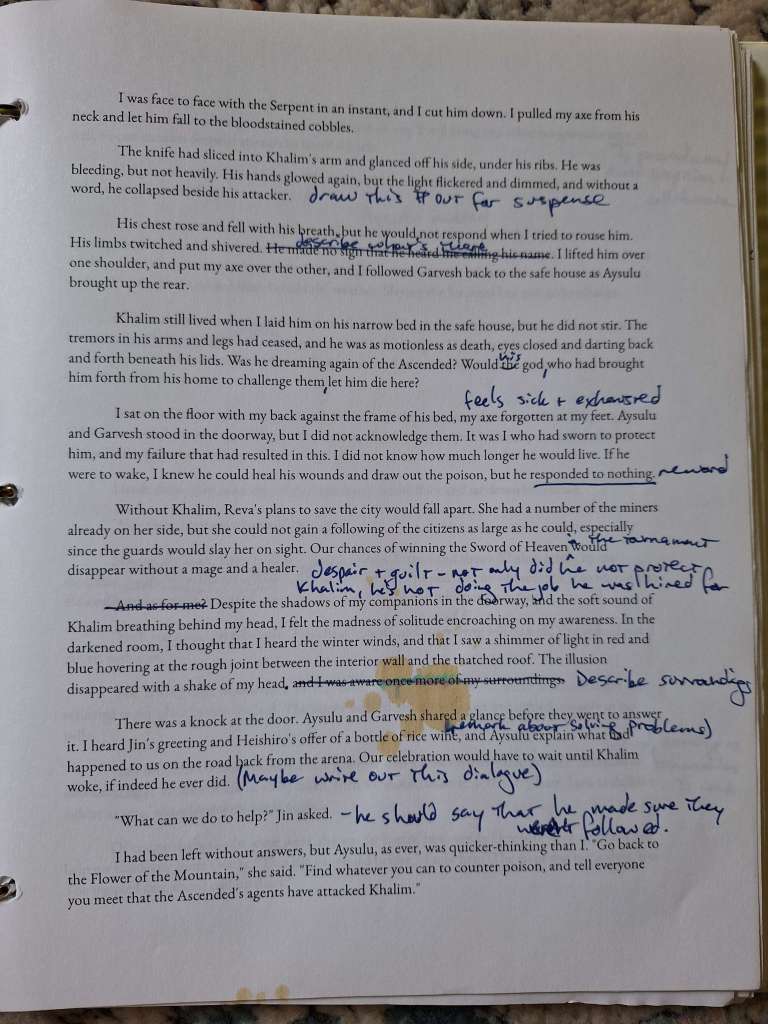
Looking back, I notice that I hadn’t gotten in the habit of circling EVERY SINGLE “was” or “moment,” but that’s a thing that I did with The Book of the New Moon Door and Journey to the Water. Also, the coffee stain is an important part of the editing process. My notes reflect what I felt the draft was lacking, as a reader and a critic, such as more insight into Eske’s thoughts and feelings, more description in places I had glossed over before, and a plot detail (the characters have just encountered some assassins, so it’s important that the new arrivals to the hideout note that they weren’t followed).
Now that I’m done with the reread of Journey to the Water, I have several important tools with which to begin the next draft:
- An idea of what aspects of the plot weren’t satisfying: character efforts that come to nothing, forgotten plot threads, emotional resolutions that don’t have the proper gravitas, problems that should have arisen but didn’t (Eske is afraid at one point that guards will pursue him, because they have every reason to, and they just…don’t).
- A big-picture view of how often I use certain words and phrases, both the generally accepted “bad writing” ones (“be” verbs, adverbs, “for a moment”) and ones specific to the draft (if one short paragraph uses the word “hands” four times, now I know, or the aforementioned “greats”).
- Notes pointing out all my typos, punctuation errors, missing words, etc. This doesn’t mean that the next draft won’t grow new ones, though.
- Notes on where I can add more description or detail, to slow down the pacing and paint a better picture for the reader.
- An idea of how fast or slow the pacing is overall, where it speeds up, and where it lags.
- A vague idea of how I want to structure the novel to better suit the story. For Journey to the Water, that’s going to mean fewer, longer chapters based around different locations, rather than the many short chapters it has now. Drawing from Conan the Barbarian, I want it to feel more like a series of self-contained adventures that build toward a larger plot. For The Book of the New Moon Door, I also combined chapters (usually in pairs) and alternated POV between Berend and Isabel on a stricter schedule than the earlier, serialized version.
Back in my lit classes, we always talked about how each aspect of a text “contributes to the meaning of the work as a whole.” How do Hamlet’s doubts about the nature of the ghost, Ophelia’s breakdown, and Claudius’s guilt all tie into the larger themes of Hamlet that you’re talking about in this particular paper? How about the word choice in a particular soliloquy? How about the rhyme scheme in the play-within-a-play? Now, I’m not doing this kind of analysis of my own work, and I don’t suggest you do it for yours, because that sounds boring and way too self-centered and a huge waste of time, but you should start getting a vague idea of what the “meaning of the work as a whole” is. What do you want to say, and how do you want to say it? If you can figure that out, you can go into your next draft and do it on purpose.
Again, this all comes back to distance. You need to be able to see the big picture. For me, that means time away from the project, a dramatic change in formatting, and a pause on the emotional attachment. Your book, and mine, aren’t brilliant yet, and that’s okay. They’re just words on a page (or a lot of pages), and they can become better words, words that give the reader all the excitement and joy and sorrow and horror that you felt while coming up with them. In order to do that, though, you need to be the first reader and see it for yourself with a reader’s eyes.
This probably isn’t anything new to most people, but I hope you find it interesting or a little helpful. If you have critiques of my process, questions about it, or just want to say hi, comments are open below. Wish me luck on my rewrites!

 Space Whales Press
2 thoughts on “Some notes on editing”