The gods weep when a Son of Galaser dies.
Berend would know. It rained for five days after the battle on Braenach Hill, seven years ago, when nine Sons out of every ten were slaughtered in the grass. He stood in the mud, afterward, water pouring down on his bandaged head, listening through the ringing in his ears to the announcement that he and the handful of others who were still breathing would be out of work, as part of the terms of their employer’s surrender.
Not many walked off that hill. Even fewer are still around.
And now one of them lies in six pieces on an embalming table.
Berend takes another swig of cheap whiskey from his flask. The liquor burns on the way down, but it’s warm. “I’m sorry, Mikhail,” he says to the wet, gray evening. “You didn’t deserve this.”
The rain beats a steady rhythm against the soft earth, and distant thunder rolls over the field. Water runs from the chapel’s gutters, pressing a rut into the mud beneath. The little overhang above the door keeps Berend dry, more or less, but the wind bites, and he shivers.
He lets himself indulge in one moment of longing for the Widow Breckenridge’s feather bed. She did say she’d like the pleasure of his company, now that he was back in Mondirra after being gone more than a month, but he’s got to do this for Mikhail. He can sell his good doublet, scrape together enough for a proper funeral—and a headstone, maybe, or a plaque. Something to tell people that Mikhail Ranseberg lived, and he mattered.
The nearsighted old monk who runs the chapel offered to perform the rites and bury him here, in the blue field, in a hole marked only by the tiny flowers that give the place its name. Berend refused. He’s going to do right by Mikhail. The man may have been a drunk and a vagrant these last few years, but he was a Son of Galaser, and that name carries weight even though few remember it.
That’s why Berend is waiting here, in the middle of the night, by the chapel in the blue field. So that someone is looking out for Mikhail. If only he’d done a better job of it before.
It’s getting colder, and the thunder comes nearer with every crack. Where is the blasted Sentinel, anyway? The old monk—Risoven, his name was, as old-fashioned as his church—sent for one hours ago.
Berend squints into the darkness and suppresses another shiver. In this weather, at this time of night, the Sentinel probably isn’t coming. He wanted to wait, and stay out of the same room as the body and the reek of blood, but he’s one more lightning strike away from changing his mind, even though it was he and not the constable who insisted Brother Risoven send the message. How much good will a Sentinel do, anyway? They’re a dying breed, much like the Sons. He’s seen them talk to ghosts, ask them questions, and send them on to Lord Ondir’s cold and loving embrace, but that was years ago. Still, he wants to know who did this to Mikhail. Constable Mulhy has yet to find any witnesses, and Mikhail himself isn’t exactly in a state to talk. A Sentinel might be the only chance they have.
Mulhy paces the chapel, his shadow moving back and forth under the door. Risoven has lit enough candles in there to turn the tiny church bright as midday. It must be good for Mikhail’s spirit, or maybe it’s just that the old monk can’t see so well in the dark.
And by the Seven, it’s dark. The storm will reach the chapel’s sagging roof any moment now.
Berend takes another drink and stomps his feet on the small square of dry ground beneath him to restore some feeling to his toes. He wishes he’d worn his heavy cloak. He wishes someone hadn’t decided to rend poor Mikhail limb from limb, but here he is. It must have been some crime boss, sending a message to his rivals. Mulhy says things have been quiet in the Shell District where Mikhail was found, but that’s clearly not true anymore.
Hoofbeats roll in underneath the next rumble of thunder, soft and quiet on the wet soil. Berend leans out into the darkness, putting his hand over his good eye to keep the rain out. Water trickles under the patch over the other eye. Just as he’s convinced he imagined the sound, a flash of yellow-white lightning shows the shadowy figure of an aging gray mare carrying a woman in a faded black traveling coat, coming slowly up the path between patches of trembling blue flowers.
The woman dismounts in the watery patch of light outside the chapel window and regards Berend from under her broad-brimmed felt hat, also black. Her skirts are tucked up into her girdle, revealing a worn pair of boots laced up to the knee. “Isabel Rainier,” she introduces herself. “I’m the Sentinel.”
That much is obvious, from her blacks to the fact that she’s out in the blue field in the middle of a storm, to the silver pin on her coat in the shape of an arched gateway. Interesting, that she’s a woman—all the holy warriors Berend ever met, and there haven’t been many, were men. An arming sword hangs at her hip, a short blade with a simple swept hilt, among other objects hidden in the darkness and her skirts. The sword is part of the uniform, but Berend has never asked if a Sentinel can wield it, or if it’s made of silver or some such nonsense.
There are more pressing matters at hand. “Berend Horst,” he says with a tip of his own hat, also broad-brimmed but scarlet red. A bow would take him out of his shelter by the door, and that’s a step he’s unwilling to take right now. “You’re here for Mikhail Ranseberg, I assume? He was my friend.”
“I’m sorry for your loss,” says Isabel. The words are gentle, but there’s a hint of rote repetition about them. She ties the mare’s bridle to the post supporting the overhang. “Is he inside?”
Berend moves to the edge of his dry spot with a nod, and Isabel removes her hat and enters the chapel. A wave of light, smoke, and a miasma that might be decaying flesh pours out of the door. Berend has seen—and smelled—a lot of death in his time, but the unbidden thought of Mikhail’s poor corpse roots him to the ground.
He takes one last drink to steel himself and pours the rest out into the mud, a libation for his comrade. Let’s get this over with.
Inside, incense wafts from three separate censers, not quite covering the persistent smell of death. The many candles cast a wavering, eerie light, and Brother Risoven’s shadow stands tall and spindly against the chapel walls. Berend places his hat on the bench closest to the door, careful not to crush the feather, and crosses the short distance to the back room behind the altar. Constable Mulhy keeps watch in front of the door, arms crossed over his chest. The spiral embroidered on his vest, marking him as a constable of the Shell District, catches the candlelight as he shifts his weight between his feet. He glances behind him at the darkened room, a troubled frown crossing his young face.
“I don’t like ghosts,” he says.
Neither does Berend, but if this is what it takes to find justice for Mikhail, then he’s going to bear witness to it. He nods to Mulhy and steps over the threshold.
“Stop!” Isabel commands. “Don’t touch that.”
Berend’s boots catch on the floorboards, and he throws his arms out to keep from falling. Two lines of chalk mark the ground in front of his feet, stretching out into a pair of concentric rings circling the room. At the center is the table where a shape that isn’t much like a man lies under a sheet.
As much as he doesn’t want to be in that room, he also doesn’t much like the idea of being kept out of it. He’s the closest Mikhail has to next of kin. “Can I stay here, then?” he asks.
Isabel looks up. She kneels beside her circles near the opposite wall, a thick piece of chalk in her hand. “I suppose. Don’t break the circle.”
She’s moved half a dozen candles from the chapel and placed them on the floor. Her coat and hat are slung over a chair in one corner of the room. From underneath them, the hilt of her sword shines in the flickering light. Berend had thought she might move the body, placing it in order instead of leaving it in a pile, but it’s the same as when he arrived here hours ago. At the edge of the table, an iron handbell weighs down a corner of the sheet, and an octavo-sized book bound in black leather lies propped up against it. The same symbol of an archway is embossed on the front cover.
Isabel draws a curving sigil into the space between chalk rings and stands up. The chalk disappears into her skirt pocket, and she brushes dust from her hands before snuffing out each candle between her thumb and forefinger. She’s a mousy sort of woman, tall and thin, with large eyes and a pointed face. It’s hard to tell her age; Berend guesses thirty or thirty-five. Her dark hair is pulled back into one long braid, heavy with rainwater.
The last candle goes out. Blackness swallows the room, turning the threshold into a precipice over a bottomless void. A tremor vibrates through the air, humming like a taut string. Pressure, like the wind outside, pushes against his body from the edge of the circle.
A match flares to life, burning a bright spot into Berend’s vision. Isabel lights a single candle of black wax, setting it into a small cup formed of branches of wrought iron. It sputters, and shadows bend and waver up and down the walls. She sets it down on the table beside Mikhail and picks up the book. With her other hand, she takes the bell and rings it once, a clear, piercing note. The sound fills the room and spills outward, seizing hold of Berend’s body and bending the beat of his heart to the rhythm of its reverberations. He wants to look away, to shake off the peculiar sensation, but he cannot move. He can only watch.
“In the name of Isra, mother of creation,” Isabel recites, her gaze turned away from the book and toward the empty air, “and of Alcos, king and father, and of Ondir, lord of the gates: I call the name of Mikhail Ranseberg. Hark to me and speak!”
The bell rings again. In the small, still room, the echoes fade to silence. Berend’s pulse hammers in his ears. He takes a breath, slow and shaky, afraid to disturb the quiet.
Then, there is a deafening, distorted scream.
It’s almost a human voice, but not quite—it is like metal scraping against metal, like an animal being slaughtered. It is many voices all at once, so loud the entire city must be able to hear it, and it goes on and on in wordless agony. Mulhy covers his ears with his hands. Berend clenches his fists, holding his arms at his sides.
Is that Mikhail screaming?
Isabel takes a step back. She holds up the bell, and its rim catches the light, but the horrible din swallows any sound it might make. Light blooms in the air above the table, not firelight but something eerie and pale, flickering with distorted shapes—first half of a face, its mouth open and twisted with terror, then an outstretched hand, and then the meeting of a shoulder and a neck, muscles straining. It might be Mikhail, but there are only flashes, too fast to recognize anything.
Isabel rings the bell one more time. The screaming continues, shaking the building, from the dusty ceiling to the floor beneath their feet. Berend relents and puts his hands over his ears, but the sound is no quieter, as though it’s as much inside his head as out of it.
At last, Isabel reaches out and knocks over the candle. Darkness and blessed silence smother the room.
Berend’s ears ring with a high, insistent tone. He swallows, and the ringing lessens. “I take it that wasn’t supposed to happen,” he says.
Brother Risoven brings a light, his robes rustling and his eyes squinting through his thick lenses. “Is everyone all right?”
“I think so.” Isabel has bell and book clutched to her chest as she stares at the body under its sheet. She shakes her head and places the objects down one at a time. “A broom, if you would, Brother.”
Risoven sets the lantern down in the doorway, just outside the chalk circles, and hurries off.
“What does this mean?” Berend asks. “What just happened?”
“I assure you, Mr. Horst, everything is under control,” says Isabel. Her face is a neutral mask, but her eyes are wide, and her voice comes out too high and too fast.
“Under control?” he echoes. “That’s happened before, then, has it?”
“No, it hasn’t,” she admits. Risoven reappears with a broom, and she takes it and waves Berend off. “If you’ll excuse me for just a moment?”
As Isabel sweeps away the chalk on the floor, Berend follows Mulhy and Risoven back out to the chapel. She’s not going to try it again, then.
He slumps into the first bench by the altar, under the faceless gaze of the carved figure of hooded Ondir. His hands are shaking. He clenches his fists to keep them still.
Something terrible has happened to Mikhail; something that has even the Sentinel spooked, and Sentinels are a stoic bunch. So are Shell District constables, but Mulhy is pacing again, tugging at his tawny hair with one hand.
The spell failed. It happens all the time. There’s a reason Isra’s priestesses mend bones with time and splint these days, just like everyone else, instead of inking sigils over the skin and chanting. A Sentinel of Ondir would be no different. Berend will just have to find the madman who did this to Mikhail himself, using mundane means—such as violence, and threats of violence. He left his pistol and his saber at the Fox and Dove, his lodgings for what’s left of the night, out of respect for the chapel. He can always fetch them later.
But if the magic had failed, nothing would have happened. We wouldn’t have seen or heard anything.
Isabel sets the broom in the doorway and enters the chapel. She sits down at the opposite end of Berend’s bench, her hands folded over her dusty skirts. “I need you to tell me everything about where and how you found him,” she says.
“He was in the Shell District,” says Mulhy. He stops his nervous route in front of the altar and taps the patch on his vest. “At the center of the old plaza. I found him like that, just at sundown.”
“Did anyone see what happened?” asks Isabel.
Mulhy scratches the back of his neck, not for the first time, judging by the angry red welt there. “No one has come forward.”
Impossible. No one could cut up a body and leave it in the middle of the Shell District without any witnesses. If Mulhy is going to be just as useless as the Sentinel, Berend will have to find those witnesses for himself as well.
“Interesting,” Isabel says. “Can you take me there?”
“I…I suppose so,” Mulhy stammers. His eyes flick between his spiral patch and Isabel’s black dress. Legally speaking, his authority outranks hers, unless there are ghosts involved.
“I think it would help,” she says, with a reassuring tone that Berend can’t help but hear as hollow. Her unkempt brows draw together in a troubled frown as she brushes chalk dust from her clothing.
“Shall we, then?” Berend interjects. He claps his hands together and gets to his feet. “There’s no time to waste.” And if these two are going anywhere, he’s coming with them.
His sudden enthusiasm gives Isabel pause. “I’ll get my coat,” she says.
***
The Shell District sits inside Mondirra’s southern wall, half an hour’s walk from the chapel on the blue field. It’s a sprawling, ugly stretch of the city, the original houses and shops built over with layers of additions and lean-to shacks, rotting wood and cheap plaster covering old marble. The mosaic-tiled plaza from which the district takes its name, imitated in thread on Mulhy’s vest, was once open and clear and polished every second day, or so people like to say. The dirt of centuries covers the tiles now, and only a small circle at the center, maybe fifteen feet in diameter, remains clear of dubious architecture.
Here, at the center, is where Mulhy found Mikhail. Two other constables stand watch in the gap between two sagging wooden roofs, holding lanterns and yawning. Despite the rain, a smear of blood remains on the origin of the spiral. It isn’t much. Mikhail’s flesh had been a bloodless gray.
Whoever did this hadn’t cut him apart here. He’d been brought here from somewhere else, which means there might be a trail—or there was, before the storm came through. A fine mist hangs over the district, and the constables’ lanterns are ringed in yellow light.
Isabel enters the small space and stops before the bloody smear. Her hat shields her eyes, and her hands fidget in her pockets. If she notices the many pairs of eyes watching her from the dark windows overhanging the circle, she ignores them.
Someone must have seen something. Berend walks all the way to the edge of the old plaza and back, but there’s no more blood, only the city’s filth all turned to mud in the rain. With the buildings leaning into each other, pressed close together like drunken companions stumbling home at night, his line of sight reaches only a little farther than the reach of his arms. If one were careful, one might be able to drag the pieces of a body into the plaza without being seen.
The constables must have dragged a few of the squatters out for questioning already. Either they truly hadn’t seen anything, or they’re more afraid of Mikhail’s murderer than they are of Constable Mulhy. Berend can’t blame them.
He’ll try a different alley. No fewer than eight of them lead out of the plaza. He turns on his heel to head back toward the center.
Something wet glistens in the dim light of the constables’ lanterns. On the side of the building to Berend’s left, a dark line reaches from the ground all the way up the plaster wall and under the width of the awning. On the other side, another line mirrors it, straight and sharp-edged as though it was painted with a brush.
A dank smell fills the narrow space. Berend bends in close to the dark marking and sniffs. The unmistakable odor of old blood fills his lungs, along with something else, like damp and rot.
“Sentinel,” he calls across the plaza. “You should look at this.”
Isabel comes over at a brisk walk, a hand on her hat to keep it from falling. “What is it?”
Berend points to the lines, first on the left, then on the right. “What do you make of it?” he asks, before she can ask him the same thing.
She examines the wall at eye level and tilts her head back, holding her hat in place. Still facing up, she backs into the plaza. “Look,” she says.
Berend follows her gaze and finds another line, down the side of the next building, and another up the side of the rickety lean-to a few feet away. In the next alley, under a pair of awnings close enough to touch each other, the same sticky substance travels down one wall, across the dirty tile ground, and up the adjoining wall.
What is this? Is this Mikhail’s blood? There’s so much of it.
“It’s a circle,” Isabel says. “It must go over the roofs, as well, or it did before the rain.”
It’s enormous. “You’d have to be a hundred feet in the air to see the whole thing,” Berend says. “Why?”
“I don’t know.” She ducks under the awnings and taps her finger against the right-hand wall, just underneath a symbol on the plaza side of the circle. It looks like a pair of many-branched candelabras, joined at the stems, painted of the same substance with a fine, small brush.
“What’s that?” At least to his own ears, Berend sounds calm, though his pulse has taken up its frantic rhythm against the inside of his skull. The blood-and-rot smell is stronger here, and the hairs on his arms and the back of his neck stand on end.
“A sigil, of some sort,” Isabel says. “I don’t recognize it, but this is clearly a magic circle.”
Clearly. But most magic circles are drawn in chalk, and aren’t as big as a whole district, and don’t look more like fresh blood with each passing second. The surface ripples like a still pond, or a dirty puddle, and tiny red-black growths like branches or fingers reach into the air from the liquid surface.
Berend jumps back. His stomach turns, and his skin prickles, like he’s been beset upon by a nest of insects. “Sixteen hells,” he mutters.
Isabel reaches out and puts her fingers around the largest growth. It snaps off into her hand, leaving reddish dust in the creases of her palm.
“What is that?” Berend asks. “Are you sure you should be touching it?”
She holds the misshapen thing up between them. He turns his face away. Nothing good can come of breathing in that dust.
“It’s a fungus,” she says. “It’s not an uncommon side effect of an improperly woven spell. Whoever it was is lucky the district didn’t explode.”
Berend’s throat constricts, and not from inhaling red spores. “What are you saying, exactly?” he chokes out.
“Someone used your friend’s body and blood to cast illegal magic,” Isabel says, “and it went terribly, terribly wrong.”
I hope you enjoyed this preview! I’m so thankful for your support.
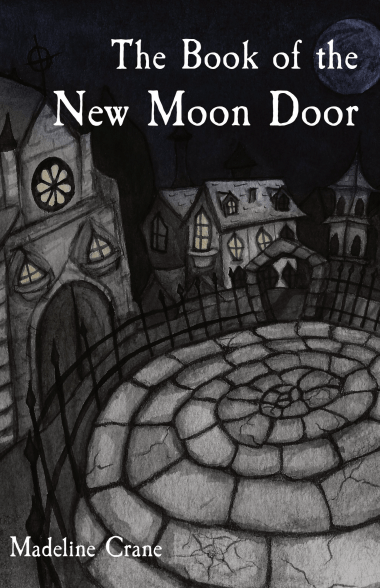
The Book of the New Moon Door releases December 15, 2023.

 Space Whales Press
3 thoughts on “The Book of the New Moon Door, Chapter One (Free Preview)”