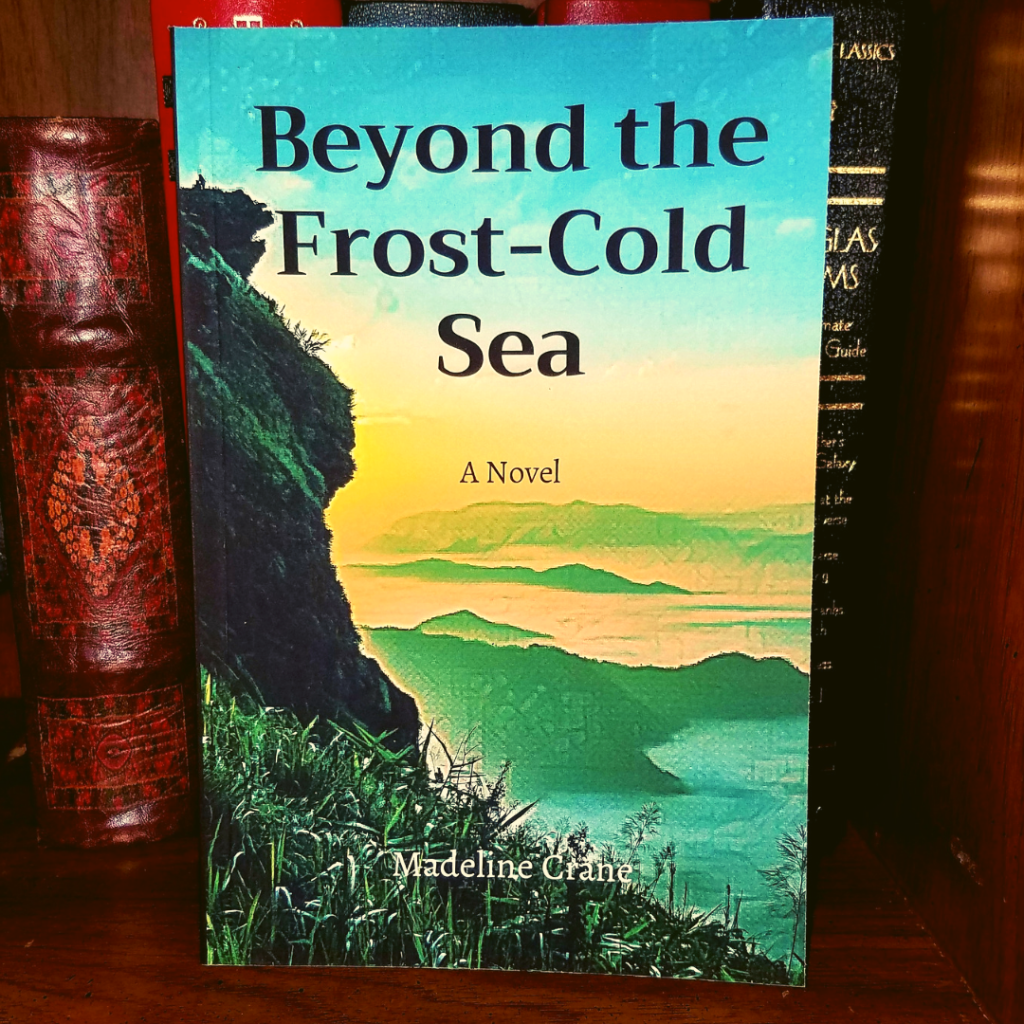
The version of Beyond the Frost-Cold Sea that you can purchase and hold in your hands (or your e-reader) is the same story as the serial version that was published chapter-by-chapter here on the blog between 2019 and 2020, but it has been improved upon in several key ways! I thought I would spend some time talking about that process and the work that went into making it a “real book.”
Each chapter of my serial projects is roughly 2000 words (or four single-spaced/eight double-spaced pages on a word processor). This is an output that I can easily manage week by week while keeping up with my other projects (as well as my household), and it makes for a quick read while you’re waiting for a bus, on a break, or standing in line. I know that everyone is burnt out and busy, and I don’t want following my writing to be a huge endeavor that adds to your already packed schedule.
However, I do want each chapter to be worth waiting a week or two to read, so each one usually contains at least one significant plot development. Chapters where all the characters just hang out, rest, and talk with each other are few and far between. This makes the pacing of each of these stories extremely fast. I printed out the serial version of Beyond the Frost-Cold Sea and began to edit by reading it front to back, and I was struck by how quickly it moved from plot point to plot point without any breaks in between. A huge part of my editing process was to expand description to really get the reader into the world, put in scenes where the characters react to what happened during action sequences (and develop them as people in the process), and give the story room to breathe a bit. I expanded side plots, like Aysulu’s brief romance with Roshani of House Darela and the mission of the disciples of the Dragon Temple. Descriptions of characters and their costumes were also made longer and more detailed. The serial version finished at 78,713 words, including chapter headings, while the published version is 91,179 words. That’s an increase of more than 15%. The published version isn’t a slow book, by any means, but the pacing isn’t quite so breathless and rushed. It has space to develop the world and the characters and tell the story I wanted to tell.
Another major part of editing was continuity. I have a confession to make, dear reader, and I hope you’ll forgive me: I don’t always (or even very often) go back and read previous chapters before I write and post a new one. Perfectionism, and the procrastination that goes along with it, is one of my nemeses (the other being the Instagram/Facebook algorithm). Doing these serial projects gets me to actually write things and finish them, as well as giving you something to read in the meantime. Too much rereading stalls me out and prevents chapters from getting done. So, I don’t always go back and check the exact spelling of fantasy names, whether a character was injured on the right or the left side, or the precise details in the description of a temple. And because new chapters come out with a week or more between them, you probably didn’t notice. (If you did, you have an impressive memory, and you can feel free to yell at me about it in the comments.) Sitting down to read Beyond the Frost-Cold Sea from start to finish, as one would do with a published book, made those errors stand out. I made sure to correct them as I went through the manuscript again and again, as well as catching any typographical errors that inevitably slip through when one as is as bad at typing as I am. The manuscript went through five or six full rewrites before it went to the distributor.
The function of the first draft is to make the story exist, and the serial version of Beyond the Frost-Cold Sea was, generously, maybe the second draft (chapters usually get reread once by me and once by my patient and longsuffering husband before they’re posted). When I was doing literary criticism in college and grad school, we talked a lot about “the meaning of the work as a whole,” and how every choice of word and use of figurative language contributed to that holistic meaning. In order to figure all that out, you need to have a whole work in front of you. Once I got to the end of Beyond the Frost-Cold Sea, I discovered two essential themes that existed in the text but needed some work to refine them:
- The gods are cruel, even the “good” ones, because they do not love like mortals do, and
- Human agency in the face of indifferent destiny is paramount.
Eske clings to the idea that he has power over fate in order to avoid feeling helpless when confronted with dangers of mythical proportions, natural disasters, and the gods themselves. That helplessness, the thought that nothing he does matters, is the feeling he most tries to avoid throughout Beyond the Frost-Cold Sea and Journey to the Water, and this avoidance spurs him onward even when he might be tempted to give up. Khalim, on the other hand, has chosen almost nothing in his life. Since he was a child, a god has been directing him through dreams of the future, culminating in his visions of the doom of Phyreios that compel him to leave his home and try to prevent the disaster. Once he arrives, Reva takes him under her wing, for his own protection as well as for her plans to use him to inspire the people to overthrow the Ascended. Left to his own devices, he would have set himself up as a healer in the slums and avoided the tournament altogether. He would have probably also been quietly killed, pretty much immediately, as soon as the Ascended were aware of his presence. The one thing in his life that he has asserted any agency over is his romance with Eske. Khalim chooses to pursue him even when there might be more important things to occupy his attention, and even says at one point that Eske never appeared in any of his dreams. The love between them is something in which the Ascended and Khalim’s mysterious god have no involvement–it is finite and mortal, and all the more meaningful because of it.
You’ll see the difference between versions most clearly at the end of Chapter XV, where the conversation between Eske and Khalim went through a number of changes, but more subtle differences exist throughout. I discovered what the story was about, and I did a lot of editing and rewriting to bring that meaning into focus.
I think that covers all the significant differences between the serial and published versions, but you don’t have to take my word for it: you can read the serial version starting here, and you can purchase the real book from your preferred retailer here, where you can also read the first chapter of the published version for free.
As always, I appreciate every single one of my readers, regardless of what format you interact with my work! I hope you’re having a good day.

 Space Whales Press