Phyreios was in ruins. A gaping black maw lay open at the base of the mountain, where the worm had gone back from whence it came, into the bowels of the earth. Under the clear autumn sky, a miasma of smoke and dust hovered over the rubble. The survivors were few, and they had nothing but what they were able to carry, but they lived, and they would rebuild. A god walked among them, and he would lead them to a golden age of peace and prosperity—a god who wore the face of my beloved.
I left the city. Nothing remained for me there. In the company of the warriors from the Dragon Temple, I continued my wanderings, and crossed the steppe once again. We walked for weeks in a golden sea of grass, as beautiful as it was desolate, the sky pale and empty and the eight winds following our every step. It was a harsh land, a holy land. I had learned to treat it with the reverence it demanded when I had traveled with Aysulu. Our paths had at last diverged, on the plain outside the ruin, and I sorely missed her friendship.
I had with me the horse that was Aysulu’s parting gift, a black gelding as gentle as a pony bred for war could be. I named him Bran, after a raven-haired hero from the legends of my people. With some gentle encouragement from Jin and some good-hearted mockery from Heishiro, I did at last learn to ride, though I could never achieve the feats those native to the steppe did. There would be no songs sung about the bond between Bran and me, but we got along well enough.
We arrived at the base of the eastern mountains at the same time as the first snow. Jin explained that the mountain passes would be blocked, frozen over and buried under drifts, so we stayed the winter in a town tucked in the foothills. It was a trading post, a wintering place for the nomadic folk, and the lifeblood of the temple that crowned the mountain above it. The houses were built short and sturdy, and bright flags in a spectrum of colors hung from lines strung between them.
I spent the season working with the town’s blacksmith, and I learned something of the making of steel, though I could not master it. It was good to have work to do, to be exhausted at the end of the day, for I did not sleep easily. On the days the smith had no use of me, I hunted in the hills, and shared what I caught with my friends and the townsfolk.
Spring came at last, and we began our journey to the temple. The mountain turned from white to green as we climbed the narrow path, and rain fell each night and through most of the days. In the places where the path was steepest, human hands had carved rough steps into the gray stone, but most of the road was created by wind and the hooves of mountain goats. We climbed above the clouds, past the rice fields cut into the mountainside in tiers like a giant’s staircase, through gnarled trees and stands of grass many times taller than a man.
The mist parted at noon on the fifth day of climbing, and the temple appeared before us. It was built into the peak of the mountain, with tiled roofs jutting out from the stone. Around the base stood a cluster of small buildings—guest houses, Jin explained, for the pilgrims. One of them would be mine, for the duration of my stay here, with a chest for my few belongings and a simple paddock outside for my horse. I suppose I was a pilgrim, of a sort.
Jin placed the Sword of Heaven, the prize of the Cerean Tournament, in a vault on the second level of the temple. It would remain there until such a time as it was needed.
I asked him when I would be able to speak to the master of the temple.
“Not yet,” he said. “You will when you are ready.”
I understood. I was a stranger here among the clouds in this foreign land. I would do as I was instructed. And so, for a year, I lived with the pilgrims and trained with the children, and I set my eyes on the peak of the mountain, where the master was said to dwell.
In the lands of my birth, only the shamans could cross between this world and the next, and it was a complex ritual that I had never learned to perform. My training at the temple was nothing like I had expected. I learned to move in unison with a large group, keeping pace with their movements. Yanlong, the warrior whose fists could shoot flame, explained that the form was a story, a wordless tale of the movement of worlds.
The children marveled at my stature, and in the evenings they would beg me to lift them and toss them in the air. I learned their language, strange as it was to my ears. Most unusually, I was instructed to sit beneath a twisted tree and clear my mind of all thoughts—of Phyreios, of myself, and of Khalim. This proved more difficult than even the climb to the temple.
I kept my wits sharp and my limbs strong by sparring with Heishiro, when he was present. He would leave for long stretches of time, saying that he was going to continue his training elsewhere, but he always came back. He sought the power that would make him the greatest of warriors, he said, and he believed he could find it here. He had never seen the master, either, and each time he returned, he swore he would prove himself worthy. I, too, made this my vow.
Spring turned to summer, and still I was not permitted to climb the highest staircase. Though my skills grew sharper, my meditations left me feeling sick with guilt. Instead of a mind clear as still water, I dwelt on my failures, on the monumental scale of the task I had undertaken, and on the home that I had left so long ago, and these thoughts did not leave me when I went to my bed in the tiny house at night. The stars in the summer sky were all alien to me, and I could not even find the northerly guides among them that would lead me back to the lands of my people. The people of the temple continued to welcome me, but I was alone, nonetheless, my only companion the oath I had taken to cross into the realm of the god Torr and find Khalim.
Perhaps I should have never come here. But I had nowhere else to go, and I had made that oath, so I remained at the temple.
I asked Jin, again, when I would see the master, or if making myself worthy of an audience was a task I could not achieve. My training continued, and my skills had improved, but I was no monk. I could not live as they did forever.
“What would you ask of me,” I said, “in order for your master to see me?”
“That is not for me to decide,” he told me.
After a few days, I found him again, and a second time I asked the question.
“The last stairs in the temple are steep,” he said, “and you will not be able to climb them so burdened.”
I did not understand what he meant.
“Sorrow is a heavy weight to carry,” he explained. “Guilt is heavier still. It is right that you should feel these things, but if you cannot lay them down, you will never be able to cross over to the other world.”
“But I am here because of what happened in Phyreios,” I argued. “I do this because of Khalim.”
He nodded, and as we walked together he led me away from the group of pilgrims, so that we would not be overheard. “I have never made the journey,” he said, “but I have met a creature from the spirit world, and on this very mountainside I faced him in single combat. Wicked spirits will use any weakness against you. They will wear the face of one you love, speak to you with their voice, and if your vision is clouded by these burdens you carry, you will be unable to tell the difference between the real person and the impostor.”
He was silent for a long moment, his eyes distant, seeing something from long ago. “Time will pass, memory will fade,” he said at last. “What remains of those we love, after that?”
“I don’t know,” I said.
“I hope that you will, someday,” said Jin. “It is also of equal importance that you see yourself as you are, and not as you wish yourself to be.”
I shook my head. “It is customary for my people to boast, but if I have learned nothing else here, I know that I still have much to learn.”
“Good. But that is not what I meant. You see yourself as the center of the cataclysm at Phyreios, as though it was by your will that everything that happened took place. As though it were you alone who must bear the burden of the lives lost. You are but one grain of rice upon the balance—one mortal man, living for but a brief flash when compared to the scale of the cosmos. And yet, there will never, in all the ages of this world and the next, be another Eske son of Ivor. You must know who you are, in order to walk in the other world and not be deceived.”
It was a riddle. In my frustration, I wished to argue with Jin, but out of respect for the generous hospitality he had shown me, I held my tongue. I returned to my training, and his words followed me throughout the coming weeks.
A blaze of red overtook the mountain as autumn came. The rice harvest was brought in from the terraces below, and a festival took place, with music and a feast and a display of multicolored fire and a chain of dancers wearing the shape of a many-legged, serpentine dragon. For a while, I forgot my struggles, taken up in the beauty and joy of it.
Perhaps something had changed within me, though I felt no different. Nightmares still haunted my cold, narrow bed in the pilgrim’s house, and I still could not meditate as the monks did, but there came a day in the dead of winter that I was called to the top of the temple to speak with the master.
I was given a warm coat, a paper lantern, and a walking stick, and nothing else, for one could not carry burdens up those final stairs. I passed through the high doors, where a pair of dragons in gold lacquer faced each other on the red-stained wood, and I climbed.
The stairs emerged onto the bare mountain face. Here, trees could not take root, and there was nothing but bare stone as far as I could see. Snow blew across the path, stinging my exposed skin. I covered my face with one arm and gripped my walking stick, and I forged ahead blindly.
The wind was harsh, but my steps were true, and at last I came to the top of the stairs. I saw the ruins of an ancient temple, fallen so long ago that the only thing that remained was a flat, circular plain. The once mighty columns were only low piles of rubble, half-buried in snow.
I crossed this space, leaving footprints that disappeared even as I made them, and found myself face to face with the dragon.
Her head was as big as a longship, as tall as the sails, with a pair of branching antlers as large as mighty oaks scraping the gray clouds above. Snow collected in the crevices of her face. The feeble light of my lantern reflected back in her iridescent sapphire scales. Her eyes were bright, with a light of their own. Behind her, the coils of her body disappeared into the gloom of the storm.
She reared up. I saw, for a flash, the face of the lind-worm as it prepared to swamp my boat on that cold northern sea, and brave Fearghus on the rudder, the last I ever saw of him. I recoiled back with a start, losing my balance. The lantern fell from my hand and went out.
I managed to gather my wits and right myself. This magnificent, terrifying creature was none other than the master of the temple—indeed, this was the dragon from which it took its name. I fell to my knees in the snow, pressing my face to the ground.
The great head lowered again, a pair of writhing whiskers trailing against the stone. A steaming breath stirred my hair and the fur of my coat as she took in my scent. I shivered, from the cold seeping through my clothing and from a deep, primal fear.
“So,” she said, and her voice was inside my head, loud as thunder, chasing away any thoughts I might have had. “You are the wanderer from the North.”
I took a breath that tore at my throat. Hoarsely, I shouted above the noise of the wind. “Yes. I am a long way from home.”
“Who are you?”
The question struck my mind like a hammer upon an anvil. It was more insistent than fear, more unrelenting than desire. I had no choice but to answer truthfully.
I staggered to my feet. “I am Eske, of the Clan of the Bear. I am a wanderer, yes, and world-treader, and champion of the Cerean Tournament.” I looked into the eyes of the dragon, and I said, “And I love Khalim. You may not know his name, but he was a healer, a servant of the gods—a mortal man, for everything that signifies.”
The dragon’s head settled back atop her coils, and she studied me, the weight of all the ages she had seen carried in that gaze. I knew that she heard me, even though the winds howled and my voice could not carry.
“A great injustice has been done,” I said. “And because I love Khalim, I mean to set it right.”
The voice in my mind was softer, but no less painful to bear. “And who are you, to decide what justice is? The people of Phyreios, sacrificed in the arena—will you seek justice for them, as well? Those crushed in their homes, under the body of the worm, what of them?”
“The ones responsible for the destruction of the city are gone.” I bowed my head, unable to bear the dragon’s eyes any longer. “And I am only one man. Khalim was betrayed by the god he trusted and served faithfully all his life. If my love for him is worth nothing else, then let it be worth righting this wrong. I was told you had the wisdom that would aid me in my quest. I humbly ask for your help.”
The mountain shook as the dragon uncoiled her tail. “If you wish to see your beloved again, you have no need of my help,” she said. “You have only to serve the same god for the rest of your natural life, and at the hour of your death you will join him in the place that god has made.”
“I cannot do that. I cannot worship the one who stole Khalim from me.”
“Then you wish to defy the will of that god, to defy the order of the world?”
“Yes,” I said. “He is not a wicked god. He is nothing like those who enslaved Phyreios for an age and brought about the destruction of the city. I believe he will fulfill everything he promised the people. In this instance, though, he did wrong.”
Her whiskers curled in what might have been a smile. “It is right for mortals to defy their gods from time to time. They grow stagnant, otherwise, and waste their lives in meaningless toil. I was worshipped as a god once, an age ago—did you know that? This arrangement, I think, is a far better one.” At the base of her coils, her mighty five-fingered claws folded together, a strangely human gesture. “So. What is it that you are proposing to do?”
“I will cross over into the other world. I will find the realm of the god Torr and enter it, and I will find my beloved and take him back with me. Failing that, I will remain there with him, for as long as he will have me. Will you help me?” I asked. “Know that I will perform any service, bear any hardship, anything you ask of me.”
“You speak as if it were simply a matter of finding a ship and sailing out at high tide,” the dragon said. “The way will not be easy, and it will not be unguarded, and steel alone cannot defend against spirit.”
I bowed, back straight and hands at my sides in the way I had seen the monks do. “I have learned enough in my time among your disciples to know that I have much more to learn.”
The dragon raised her head once more, and her shadow fell over the temple ruins where once she held sway as a goddess. “Very well, Eske of the Clan of the Bear. I will aid you on your quest. But understand this: your preparations have only just begun.”
Forward to Chapter II: The Road South
Thanks for reading! I hope you’re enjoying this new project. Journey to the Water, like all blog content, will always be free. If you’d like to support what I do, and help provide for my cats, you can toss a couple dollars my way on Ko-fi.
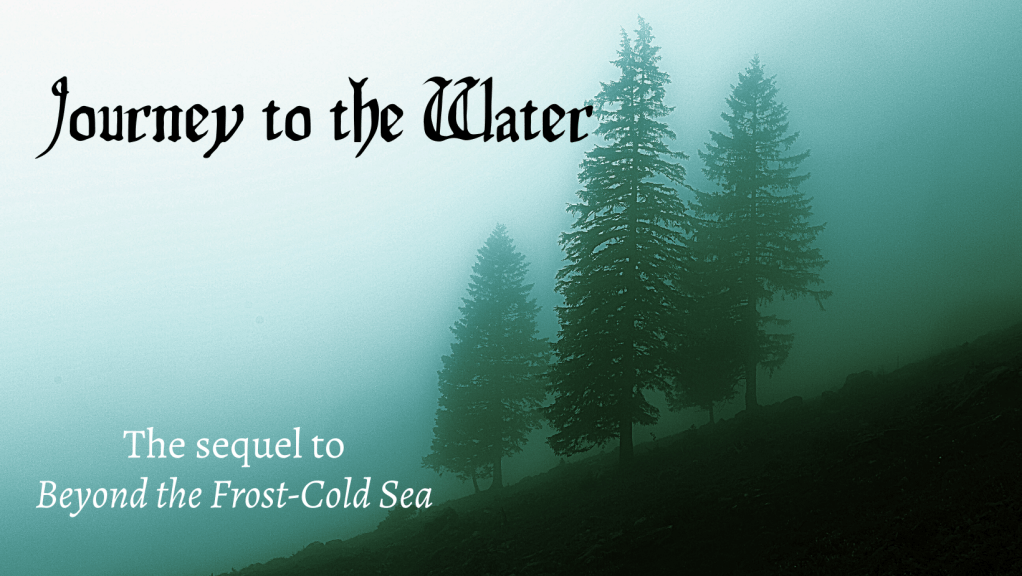
If you’re new here, this is the sequel to Beyond the Frost-Cold Sea. You don’t need to have read that one to read Journey to the Water, but if you haven’t yet and would like to, you can find it under the Stories tab at the top of the page.

 Space Whales Press
2 thoughts on “Journey to the Water Chapter I: The Dragon Temple”