We made our way back to the gate, a grim procession through the rain and the rubble. Phyreios had truly and utterly fallen. There was nothing left of the temple at the foot of the mountain, once the city’s most magnificent structure. Of the arena, all that remained was a few broken pillars of soot-stained white marble, standing half-buried in a bed of broken stone. Over the husk of the city lay a miasma of smoke, and the rain brought up a thick fog. I could not see much farther than the reach of my arm. The Sword of Heaven hung heavy from my hand.
I had thought that we were walking down the main road from the arena to the industrial district, one I had traveled so often during the tournament. As I lifted my aching feet again above the low remnants of a pale stone wall, I realized that this had been a row of houses. We walked over splinters of furniture and scraps of fabric; here there was the remains of a child’s hobby-horse, and there might have been a woman’s hand—I looked away.
So much had been lost. The nameless god had spoken the truth: our work was not yet done. I clung to the hope that when it had finished, Khalim would return. That hope diminished with every step through the ruin.
I heard Lord Ihsad and Reva before I saw them, calling out for survivors. There were few answers from the gloom. They led a bedraggled band of miners and a few soldiers in House Darela’s deep blue, not as many as I had expected.
“You’re alive,” Reva said. She looked at the god’s strange golden eyes, but whatever she saw there, she did not ask questions. “The others are gathering outside the wall.”
The god nodded, and cocked his head to one side as though he was listening for something. “There are still some alive here,” he said. “We must find them first.”
“What of Jahan?” Ihsad asked. “Is he not with you?” He could see the sword, now in my possession instead of his son’s.
Jin shook his head, lowering his eyes. “He fell fighting the Ascended,” he explained. “It was a noble death.”
I was grateful to Jin. I found I could not speak.
Ihsad’s face fell. He looked, suddenly, ten years older, his back bent and the creases around his eyes deep as a river valley. Reva placed a hand on his shoulder.
“There is a family trapped in a house, not far from here,” the god said, without another word for Ihsad’s grief. “Eske, you and Aysulu help them. The rest of us will continue on toward the gate.”
Aysulu glanced at me with a look that might have been concern. I did not look up to see. When she led her horse away in the direction the stranger indicated, I followed, my body slow and heavy.
This had not been a victory. The worm was gone, yes, but I could not say the city had been saved. So many were dead. I remembered the crowds in the arena, the thunder of their cheers. Now, Phyreios was silent as the grave.
It was not all quiet, however. As Aysulu and I made our way toward what had once been a merchant’s house, we heard shouting and the hammer of stone against wood. We came around a fallen wall blocking a street and found five men in the sky-blue tabards of the Ascended’s forces attempting to batter down the door. A child cried from within.
“What are you doing?” Aysulu demanded. Her voice was hoarse from breathing smoke and dust. “The Ascended are gone. Leave this place.”
The soldiers turned to look at us. Their eyes were wide and bloodshot, their clothing torn and their armor dented. Most no longer had a weapon other than the stones they had picked up.
“Silence, blasphemer!” This must have been their leader. He had one large pauldron over the mail on his shoulder; it had once been polished to a mirror sheen, but now it was blackened and damaged. “This is but a test of our faith. Our gods will rise again from the ashes and lead us to victory.”
“And you’ll spill the blood of these innocent people to ensure it?” Aysulu argued.
This man still had a sword. He drew it and leveled it at her. “Perhaps I’ll take your blood, instead,” he growled.
The others hefted their stones. Inside, the child’s weeping had faded to tired sobs.
“Enough,” I said. I lifted my own sword. Even in the sunless shade of the city, the blade gleamed darkly. “There is nothing left for you here.”
The sergeant rushed me. I knew that I had not the strength to fight him. With the last of my will, I swung the sword across, hoping that I would at least turn aside his blow and give me the time to prepare another attack.
The blades clashed with a metallic ring. His was severed neatly in two. The upper half fell, clattering, to the ground. He stopped short, his feet scrabbling in the dust, and stared.
His men dropped their stones. They ran into the fog, and soon it swallowed them up. The sergeant tossed his broken hilt at my feet and went after them.
I stood there, looking at the place they had been, too tired to move. It was Aysulu who knocked on the door and spoke to the people within. They emerged from their splintered door—a mother and a father, and two small children, dressed in the colorful robes of merchants. Their faces were dirty. The older child had a bloody bandage wrapped around one arm.
If Khalim had been with us, he would have healed their wounds and soothed their fear. As it was, they had only Aysulu and me, and we were in no state to offer comfort. Wordlessly, we continued on to the gate. The city’s wall still stood, though cracks had formed and the battlements were shaken. The gate lay open like a broken jaw.
Roshani and Yanlong were in the slums, or what was left of them. What the quakes had not toppled, the fires had brought down, and the hovels had all been flattened. There were few people to be seen. The tavern where I had first met Reva and Khalim was nothing but a hollow space dug into the earth. Yanlong was carrying a bundle of firewood, still mostly dry despite the rain. She directed the soldiers from House Kaburh to clear another alley.
Roshani caught sight of us emerging from the gate. She searched each one of our faces for Jahan. I could only shake my head.
She turned back to her work. The time for mourning would be later.
Across the stretch of land outside the slums, I could see fires being coaxed to life, sputtering in the rain. A crowd of people gathered around them. At least some had been saved. We carried as many supplies as we could—sacks of grain, jars of water, and whatever livestock had not been crushed in the earthquakes. It was not much.
I kept one watchful eye on the gate as I worked. A few more survivors emerged, and then Heishiro and Hualing. Jin followed some time after. Last came the stranger who looked like Khalim, but I could tell even from a distance that my beloved had not returned.
We gathered with the survivors by a central fire that cast an otherworldly light in the god’s eyes. The people stared at him, apprehensive. They could tell as well as I could that this was not the healer from the arena.
“My children,” the god said, and his voice carried over the crowd. “A great calamity has befallen you. But fear not, for we will rebuild. My servant Khalim has turned my gaze to you and brought me here to lead you. It was my light that healed your wounds, restored your sight, and cured your ailments. For tonight, mourn those you have lost, but take comfort. I will protect you and I will guide you.”
Light flowed from him, washing over us like a calm sea. I felt my body grow lighter and some strength return. A murmur passed over the crowd. When the spell had ended, the storm broke, and sunlight streamed through the clouds. All that remained was the smell of wet earth.
I helped hand out thin gruel in cracked bowls until I could no longer lift my arms. On the other side of the camp, the god was healing the people tirelessly as they lined up before him. I turned so I would not see him.
The last thing I remember was wondering what had become of Ashoka. I had not seen him in the city again, and he was nowhere to be found here. I hoped he had found safety.
I must have slept. I awoke when Heishiro shook me by the shoulder, his face surly.
“The fellow in charge is asking us to gather in that tent,” he said, with a nod toward a structure made of singed canvas. “Come on.”
I picked myself up. I did not ache as much as I had expected to. I was covered in soot—from the city, or from sleeping beside the fire, I wasn’t sure. It was likely a mix of both. The Sword of Heaven was just as dirty, lying in the ash beside me. I picked it up.
The sun was climbing over the horizon, bathing the plain in soft gray light. There was a line of torches coming down from the mountain; the rest of the rebels in the stronghold were traveling to join us. I wondered how much they had seen from their vantage point among the trees. To the south, I could see the banners of a mighty force stretching out in the morning wind.
I was exhausted beyond fear. If I had to, I would face them when they arrived.
The city was a wasteland. Smoke no longer rose from the ruin, but the damage had been done. No longer were there shining towers or domes that gleamed in the sunlight. Its walls were blackened, leaning against one another like tired friends after a long journey. Even from the plain, I could see the black scar where once the colosseum had been—where the worm had emerged and then retreated, back into its eternal slumber.
I entered the tent behind Heishiro. It was a familiar gathering I found there: Reva and the representatives from House Kaburh and House Darela, with Jahan’s absence keenly felt; the disciples from the Dragon Temple; Aysulu and myself. At their head stood the stranger. I thought, for the briefest moment, that Khalim was once again inhabiting the body that had been his, but I was mistaken. I stood behind the group and did not speak.
“You’ve seen the banners,” the god was saying. “Those are the men called up from the nobles’ holdings elsewhere. Most of their lords are dead. In order to receive them, we must establish a unified front.”
“We had agreed that Lord Ihsad would take the throne,” Reva said. “I was to represent the miners, but there is no longer a mine. It would take weeks to excavate it again. Even if we did, the forge…” She shrugged, a helpless gesture.
The god made a thoughtful sound and began to pace the small space at the back of the tent. “If Phyreios still stood, I would be more than willing to honor that agreement,” he said. “But now there is not even a throne to be occupied. It will require much more than mortal means to rebuild—to turn the city into the beacon of hope and peace that it was meant to be, so long ago.”
Lord Ihsad said nothing. Roshani held him by the arm, as if he needed her to keep him on his feet.
“I take responsibility for what befell my city,” the god continued. “If I had not selfishly sought my own enlightenment, if I had not left the Ascended to their own devices, none of this would have occurred. The task falls to me to right these wrongs.”
“Do you intend to rule, then?” asked Lord Janek.
“Yes,” was the simple answer. “But I will do so only with your consent, and with those of you who remain here to give me council. Are you in accord?”
A moment passed. Reva took a steadying breath and let it out in a rush.
At last, Ihsad broke the silence. “My son is dead,” he said in a shaking voice. “I will have no more children. Though my daughter could rule after my passing, the gods have shown us that it is not our destiny to lead Phyreios. My family will support you.”
“As will mine,” said Janek.
“You have saved my city,” Reva concurred. “As long as you treat us fairly, the miners’ guild will be behind you.”
The stranger stopped in his pacing and inclined his head. “I thank you. To each of you, I offer a seat in my government. Reva will represent the miners and the smallfolk, and Lord Ihsad the remaining nobles. To you, Lord Janek, I give the responsibility for the lordless men on their way here. Receive them as well as you are able, and inform them of the circumstances. We will need them if we are to rebuild the city.”
There was a murmur of assent. Still, I remained quiet.
“As for the rest of you, you are welcome to stay. I would be grateful for your efforts,” said the god. He did not sound like Khalim. I could keep my gaze to the earthen floor and pretend he did not look like him.
“We must return to our temple,” said Jin. “Already we have been absent too long.”
“Very well. I will grant you a boon, then. Eske? Would you give him the Sword of Heaven?”
I relinquished it gladly, placing it into Jin’s hands. It was a small relief, a slight weight off my shoulders, when I let go.
Jin brushed the dust from the blade with the sleeve of his robe, and then handed it to Yanlong, who produced a length of silk from inside her own clothing and wrapped it carefully. The shining dark metal disappeared from view.
“I trust that you will guard this weapon, and keep it out of the hands of those who wish to do harm,” the god said. “And I also trust that, if it ever becomes necessary, you will use it and your own divine blade to slay me. I have every intention to rule justly, but I know the Ascended did not intend to become what they did, in the early days.”
Jin bowed deeply. “We will do as you have asked.”
To Aysulu was granted one hundred horses, the finest from across the kingdom. Some would arrive with the soldiers the next day, while others would have to be found later; she would remain here, for a time. It was enough for her to start her own herd. I had spent enough time with her to know what that meant on the steppe.
To Garvesh, upon his arrival with the others from the mountain stronghold, was given the honor and the monumental task of founding the first university of Phyreios. It would be a place of knowledge and wisdom, kept for generations. It would be Garvesh’s life’s work. I could think of no better reward for him.
“And to you, Eske, son of Ivor, my champion,” the god said. “What would you ask of me?”
I looked up, finally, into his familiar face and his hard golden eyes. “Return my heart to me,” I said. “Give me back Khalim.”
He folded his hands before him, glancing away. “That is beyond my power. He has passed beyond this world—there is no path from here to there. But he is safe, and he is at peace.”
“No. He gave everything to you. He served you well. He nearly died, more than once. You cannot—after all you’ve done—” My words left me, lost in anger and sorrow. “It isn’t fair,” I said.
“I know.” He reached out, as though to touch my arm, but thought better of it. “If there had been any other choice, I would have taken it. I bear the weight of his loss as much as the city being destroyed.”
I said nothing. Tears burned in my eyes, but I did not let them fall.
“You understand that he would have perished, there under the rock?” the god continued.
It was the final confirmation of my failure. Khalim had died in my care, despite all my efforts. I had chosen to keep him close to me. My hands curled into fists, the nails biting into my palm. Still I could not speak.
“His fate would have been the same, even if I had not acted,” said the stranger. “I did what had to be done to save the city.”
I felt as though I was once again under the maddening colors of the sky over the northern sea. Despair, yawning like a chasm, threatened to swallow me. I could not form words, I could not move. Blackness swam at the edges of my vision.
The god was silent for a long while, standing very still.
At long last, he spoke again. “I could offer you closure. A chance to say goodbye.”
It took some effort for me to summon the power of speech again. “I could see him?”
He was quiet. I looked up, searching his face, but he betrayed nothing he was thinking.
“Yes,” he said. “For a short time.”
“Show him to me,” I demanded.
He shook his head. “Not now. There is much I need to do. I will find you later.”
He would say no more. I left the tent and stumbled out into the sunlight. Ihsad and Reva had already begun their labors., and what remained of the city was waking and getting to work on the very first stages of rebuilding. They gathered food, tended to one another’s children, and planned for the new Phyreios. Hope had returned to them, but not to me.
I did not want to believe what the god had told me. I wanted to think that had I been given the chance, I could have dug Khalim and myself out of the collapsed ritual chamber, and perhaps saved the others as well, and faced the great worm without divine help. I remembered the vision I had seen, buried under the rubble, of Khalim begging his god to let him stay.
Death came, I knew, for every mortal. Once we passed beyond this life, we could not return. But if this god had the power to bring Khalim back, for even a short time, then surely he had the power to create a bridge between this world and the next?
Perhaps, instead, he was not telling me the truth. Khalim would not come to me, or he would be an illusion, a trick of magic and hope.
I drank to pass the time—whatever liquor I could find that was not being guarded too jealously. I avoided the tent where the god made his command, and the refugees stayed well clear of me. After some time, Aysulu found me, glowering beside a sack of grain, and dragged me by one arm to my bed.
Someone had pitched my tent. She shoved me inside without ceremony. I lay staring at the image of the mountain, etched into the hide with charcoal, that Khalim had drawn only a short time ago. The other drawings danced around it until I lost consciousness.
I awoke to a soft knock, a shaking of the tent frame. It was nearly dark, and a red twilight had sunk over the camp. I opened the door and saw the god, his golden eyes turned molten orange in the fading light.
Or perhaps this was Khalim. He knelt before me, his long-fingered hands fidgeting in his lap. “Eske?” he said in the voice I had longed to hear for what had felt like an age, and he smiled, and all doubts fled from me.
I gathered him to my chest and pulled him inside. I held him there, his arms wrapped around my neck, and again I could not speak.
“Are you all right?” he asked, speaking softly in my ear.
I shook my head. How could I answer that question? I broke our embrace and held him at arm’s length, studying his face. He would only be here for a short while. I did not wish to forget him.
“Where are you?” I said. “How can I find you?”
He bent his head, pressing a kiss to my hand. “I’m safe,” he said. “I’m in his place, his fragment of the world beyond. A living person cannot go there. I’m sorry.”
“I can’t lose you,” I told him. “I’m going to get you back.”
Khalim reached out and wiped the tears from my eyes with his thumb. He left his hand there against my face. “It’s impossible,” he whispered. “You would have to travel beyond the edge of the world, and breach the gate of bone on a day without a sun, and cross the river of memory, deeper than the sea. Not in a hundred lifetimes could you do this.”
I could not answer.
“Eske,” he said. “It wasn’t your fault.”
“It was. I should have been faster. I should have protected you.”
He gave another smile, but it was a sad one, and it did not reach his strange eyes. “But you did. I am safe now. You must not try to follow.”
“No,” I said. “I am Eske of the Bear Clan. I am world-treader and champion of the Cerean Tournament. I have hunted the lind-worm in the far northern sea, I have survived the long winter, and I have crossed the steppe and the desert. I have battled gods and monsters. I will find you, I swear it.”
Now he wept, tears falling down his lovely face. He put his fingers to my lips. “There isn’t much time,” he said.
I pulled the blanket over us and held him there, memorizing his scent and the sound of his breath, the touch of his hands and the feel of him in my arms, all the things that were once his and were taken from him. Night fell, and a heavy tiredness overcame me.
“I will come for you,” I promised before I fell asleep once more.
When I woke, I was alone.
Somewhere beyond my tent walked a man who looked like my beloved, but was not him.
I had failed, broken my promise to keep Khalim safe. Now I had a new oath to fulfill. To travel beyond the edge of the world. To breach the gate of bone on a day without a sun. To cross the river of memory, deep as the sea.
It may have been impossible, but I had nowhere else to go.
I thought for some time where I might find the answers I sought. I had already been to one end of the world, and seen no gate of bone, though there had been days when the sun did not rise. After some consideration, I went first to Jin, and explained to him what I meant to do.
He contemplated my request. “I do not know if such a thing is possible. If anyone would have this knowledge, it would be the master of our temple. He is ancient and wise. If you wish, you may travel with us to the mountains of the East, and see what wisdom you can find there.”
I thanked him, and he told me that he and his companions would be departing before sundown.
I packed my things, carefully folding the tent to keep the drawings safe. Already they were beginning to lose their sharpness. Aysulu found me asking at the cooking fire for a few rations. More supplies had come down with the others from the fortress, but there still wasn’t much to be shared.
“Heishiro says you’re leaving,” she said.
“I am,” I told her.
She did not ask for an explanation. “I cannot go with you,” she said. “But I will miss you.”
“Will you stay here?” I asked.
“For a time. I will aid in the rebuilding. Soon I’ll have my own horses, and I’ll return to the steppe and gather my people. Vengeance was my father’s task, and now it is done. It’s time to look toward the future.”
I noticed the horse beside her. It was a sturdy pony, much like her own, though this one was black as night.
She handed me the reins. “This is the gentlest of the horses I have been given thus far,” she explained. “He’ll carry your burdens, and spare your boots, if you’ve the courage to ride.”
I promised I would consider it, though at the time, it seemed rather unlikely. “You’ve been a great friend to me,” I said. “If our paths ever cross again, I will help you in any way that I can.”
She gave me some food for the road, and told me that I might find another axe among the supplies brought down from the mountain fortress.
As I placed the supplies in my pack, I found the last flask of Cerean spirits. With nothing else to give Aysulu as a parting gift, I offered to share them with her.
“This may be the last Cerean spirits ever made,” she said. “The arena is gone. Who knows if the tournament will ever be held again.”
We drank, and parted ways for the last time.
“May the eight winds watch over you,” I said.
“And may the gods of the earth and the mountains guide your path,” she told me.
Now you have heard my tale—or some of it, at least. I went then to the far eastern mountains, and communed with the dragon that dwelled among the clouded peaks. For ten long years I have crossed the length and breadth of the earth to fulfill my oath. I dwelled for a time among the sorcerers of the south, where the trees grow as tall as the heavens, blotting out the sun with their canopies. In a deep-bellied ship I sailed the emerald waters of Ashinya, and I walked the dusty roads of Shunkare, where the sky is without end. I met Ashoka once again, when his quest for a god worthy of his worship intersected mine in the shining city of Gallia.
I did not return to Phyreios on my journey, though I have heard tell of it. It is said that it is more prosperous than before its fall, and still ruled by a divine presence. He does not age, and still wears the face of my beloved, exactly as I remember him. The people gave him a new name: Torr, meaning first in the ancestral tongue of that region, for he was the first hero who drove back the horde of demons in another age.
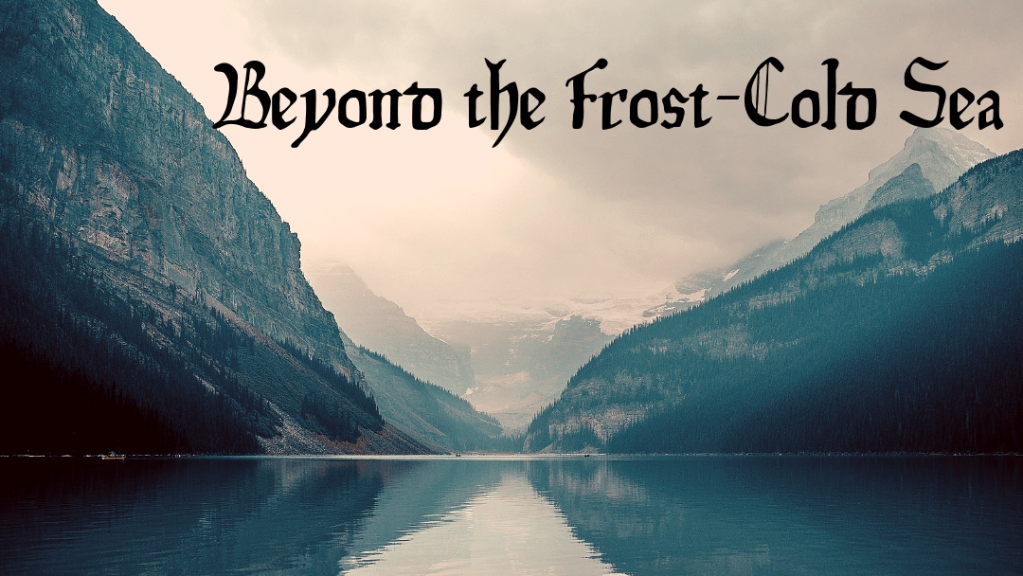
Here I stand before you. They say that this is the edge of the world, and those who sail beyond this shore never return. Soon winter will come, and with it, a day without a sun.
So, tell me, traveler: what will I find beyond this last horizon? Will I find at last the gate of bone, through which I may cross to the realm of the dead and the spirits, and bring Khalim back to my side where he belongs? I have heard that you have seen farther than any other at this final port at the end of the world. I have told you my tale, and I ask for one in return. What did you find when you last sailed out from here?
Here concludes Beyond the Frost-Cold Sea. We will return to Eske and his quest some time in the future.
Thank you for reading! If you’ve enjoyed this story, there will be more things to read soon. Check back here again!
If you are able, please consider donating to the NAACP legal defense fund.

 Space Whales Press
One thought on “Beyond the Frost-Cold Sea: Chapter XXVII”