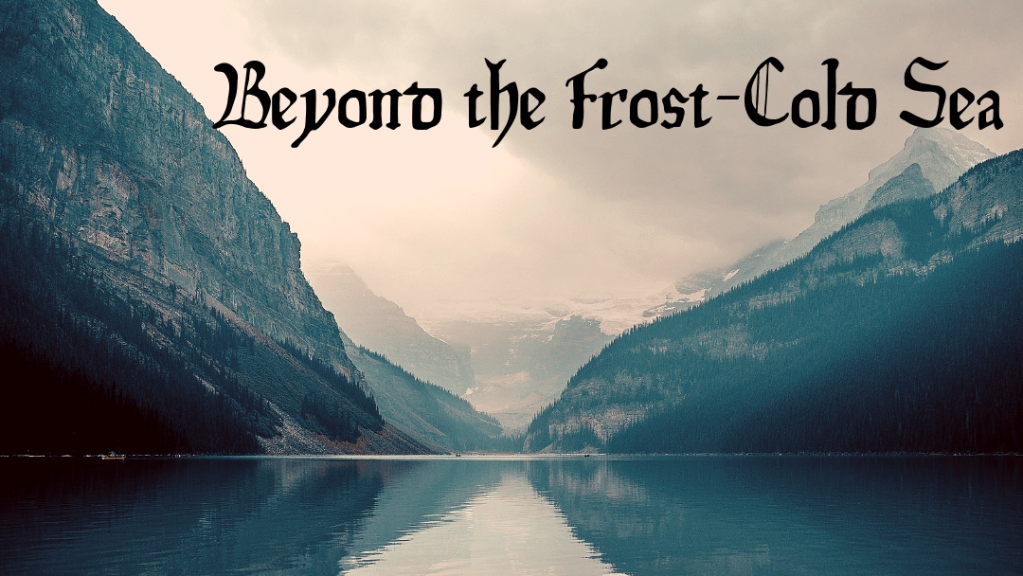
Listen. Let me tell you a story.
I will tell you of my journey, from the ocean at the end of the world to the mountain of iron, beneath which slept a horror of ages long past.
I will tell you of the daughter of the stargazer, who found me on the northern wastes at the end of my long winter.
I will tell you of the woman who dared to defy the seven gods of the citadel.
And I will tell you of the barefoot prophet, for the man who now sits on the throne of Phyreios is not the same as the one who walked among its people in the days before the cataclysm.
When I was a young man, I left my father’s hall in search of the great lind-worm of the far northern sea. Or so I had told my companions; the truth was that I was running from the wrath of my father, and from the duties that had fallen to me, his only son and the heir to the lands of the Bear Clan, as soon as I had come of age.
Fearghus saw through the lie I told myself and the others. We had shared a bed for three seasons, each of them far too brief, and he knew me best of any. Still, I longed to prove that I and my fellow warriors were mightier than the worm, and to return to my father’s hall a hero. It was foremost among the monsters that inhabited my people’s legends, and to meet it and live was alone worthy of many songs. I aimed to be the one to slay it, and be remembered forever.
We left in high summer, when the sea ice had receded back toward the top edge of the world, and the waterways were at their most open. In a mighty longship we followed the spouts of the whales north, to where the lind-worm hunted among the floating mountains of ice. The summer sun never sets in those far reaches, only touching down on the horizon each night to bathe the sea and the ice in bronze. It was on one such evening that we first caught sight of the worm. Like a distant peak it arched from the water, unfurling its coils and the shimmering sail on its back.
The drum beat faster, and the ship surged forward after the beast. Fearghus was at the rudder, steering us true, the wind in his copper hair, and the others pulled the oars in unison as we darted through the waves. I waited in the bow, a harpoon with a head of razor-sharp obsidian at the ready.
The sky darkened, and the wind tore across the sea and into our sail. We pushed onward against it, the lind-worm coming nearer and distant thunder growling beyond. Soon it was dark as the night we had not seen for nigh on a week, and an icy rain lashed down on us.
The oars carried us into the storm. The waves rose up around us, and the arc of the lind-worm’s sail stretched skyward between them. The boat lurched and rolled, but still the monster loomed larger and larger as we closed the distance. I stood in the swaying bow, the harpoon to my shoulder, waiting for the right moment.
The lind-worm dove. A wave crashed against the side of the boat, drenching my companions and me in frigid water. When the salt sting cleared from my eyes, I found myself face to face with the worm.
At first, I could see nothing but a dark shape against the roiling sky. A flash of lighting behind its massive head ignited its shining black eyes and its fangs like magnificent curved blades jutting from the yawning abyss of its mouth. It drew back to strike, to bring its jaws down on the boat and sever it in two.
I braced my feet against the hull and stared the monster down, and I laughed with the mad joy of the hunt. With all the strength I could summon, I hurled the harpoon into the worm’s open mouth. It flew between the fangs and embedded itself deep into the soft flesh of the maw. An eerie, inhuman scream cut through the din of the storm.
The lind-worm fell back into the waves. Whether it was dead or merely retreating for another attack, I know not, for when its head hit the water a towering surge swept over the boat. Our mast snapped with a terrible crack, and the hull turned over. I was thrown from the bow. I remember the sight of Fearghus clinging to the rudder, the cold embrace of the violent northern sea, and after that, blackness.
I awoke on a distant shore, on gray sand under the softer gray of the sky where the storm had passed. The beach stretched out, a narrow band against the steely, endless ocean. Behind me stood a long range of mountains, shrouded in fog. All that was left of my shop were a few broken timbers, washed up beside me. But for a pair of sea-birds circling far overhead, I was alone.
I shed what remained of my ruined armor and walked along the sand, calling Fearghus’s name until my throat was raw. I burned the timbers as soon as they dried, in the hope that someone might see the fire when the sky dimmed in the evening.
No one did. I spent what must have been weeks pacing the beach, burning what I could find and eating what fish I could catch with my hands. Two more of my companions came in on the tide during that time, their clothing rotted away and their flesh pale and bloated. Fearghus never appeared.
I remember standing in the gloom, in the gathering clouds of the false evening, the shapes of corpses and driftwood at the edge of my vision, and swearing to the gods of the sea and the mountains and of the beasts that roamed among them that I would do whatever they asked, sacrifice anything they desired, if they would only return Fearghus to me.
They gave me no answer. They never had before, and it would be a long time before I would speak to any god and hear them reply.
The endless day stretched on, until the sun set for the first time that season. The nights grew longer, and they grew colder. The sea-ways would soon be sealed shut with ice. Winter came swiftly in the north, and this year was no different.
I do not remember much from the months that followed. I walked east, toward where the songs told of a passage southward through the mountains, away from the lands of my people. I could not have returned home even if I had wished to, with no ship and the ice forming in the places where the whales had already left for warmer waters, but I dreaded to go back in disgrace, without my companions and without Fearghus. I walked until the nights were enduring and the winds were chill enough that I was forced to seek shelter and build up what stores I could before the snows came.
I think I may have gone a little mad in the long dark. Just as the sun never set in the summer, it did not rise in the depths of winter. When the moon was dark, shimmering lights filled the black sky, emerald green and blue as the summer sea, shot through with bloody red. I had seen them before, but alone as I was in the unending night, the blaze was more awesome and terrible than I had ever seen it before or since. In that light I often saw the lind-worm, undulating between the stars, with a sail formed of luminescence I felt I could have reached out and touched.
The snow must have stopped, the sun must have returned, but I do not remember the coming of spring. I do know that my stores were almost empty, and I left the cave in which I had sheltered, continuing on my way east until I had found the fabled passage south. The forbidding peaks opened up before me, and I knew then that I had traveled farther than any of my people before me—and I had survived as an exile in the long winter.
They call me world-treader, and thus I earned the title: from the sea at the edge of the world I journeyed through the bare black mountains, where no one had dared tread since the time of the oldest songs. My boots wore through, and I fashioned crude replacements from bark and hide; I ate what I could find in the underbrush, roots and quick scurrying creatures, and berries when the spring, as slow to arrive as the winter was swift, at last bloomed in the north and turned the land to green.
By that time, I had reached the foothills south of the peaks, and I could see the vast tundra stretching out in the distance, flat and featureless as the gray sky hanging above. The mountains were behind me, as was the whale-road that would take me back to the lands of my people. There were other villages here, I knew, though they were far out of sight; other clans lived in the shelter of the low hills where the soil was richer than among the mountain stones where the Bear Clan hunted and fished instead of planting. I could have tried to seek them out, to beg of them the hospitality held sacred across the harsher climes of the world, and either travel west from village to village until I had found my people or stay and live out my days as one of their hunters. I chose instead to continue south and east, to the expanse of the tundra, so alien to my eyes accustomed to a sky fenced in by mountains.
I came to a river that erupted from the rock and tumbled south, darting through the last hills and bending west before falling out of sight. The first of the red-bellied salmon were running, hurling themselves into the air in their rush to swim upstream, water droplets glittering in their wake. Hungry as I was, and with only the most rudimentary of tools at my disposal, I could not resist the lure of so much food so easily gained.
But it was not to be so easy. One of the mountain bears for which my clan had been named stood guard over this river, at the shallowest point I could see in either direction, standing watch and catching the fish in his mouth. I approached quietly, in the hope that if I appeared as no threat to him, he would let me fish and cross the river in peace. I was alone and without weapons.
The moment I set foot in the water, the bear rose to his full height, casting an elongated shadow across the river. He had been close to as tall as I when on all fours, and now he was nearly twice that. His massive forelegs ended in wicked black claws, and he was covered in coarse black fur that faded to brown on his belly. He roared, baring his sharp yellow teeth. The sky swirled with birds, startled from their gnarled trees by the sound.
I retreated into the sparse cover of the wood, keeping a watch on the bear. He did not leave the river until nightfall, but by then it was too dark for me to cross with sure feet, and I could no longer see the fish. I slept in the crook of a tree, and woke before dawn, but he had already taken his post. With another roar, he turned to me, rearing back to swipe the air with his claws.
Again I returned to the trees. The bear intended not to allow me to pass, and I was determined to defy him. The Bear Clan did not earn its name by having a lesser courage than a beast such as this. I found a sapling not yet twisted with harsh wind, and a large enough piece of flint to sharpen into a blade. Lashing them together with a leather strip torn from my worn clothing, I devised something like a spear. With that in hand, I went back to the river.
The bear bellowed his challenge when I waded into the water. I bared my own teeth, much smaller than his, and growled back. This only enraged the bear, and he drew up, his first blow swiping over my head. I struck with the spear, but it glanced off his thick fur, and I was forced to reel back to avoid his next attack. He drove me all the way to the riverbank before I saw an opening. He stood to bring both crushing paws down on me, and I drove the spear under his arm. His weight bearing down drove the point in deeper, and he was dead by the time his bulk fell on me.
The river’s strong current helped push the bear from where he pinned both my legs, and when I was free I sent the birds wheeling again with a frenzied cry of victory. I ate well that night, and for some time after, on both the meat of the bear and the fish I was then free to catch.
I crossed into the tundra as the spring gave way to summer, and the air swarmed with biting flies. Herds of great elk moved through the mists, their antlers scraping the heavy sky. At night, as I lay beneath almost-familiar stars, I heard the far-off howls of the wolves that pursued the elk across the sodden green landscape. They stalked me as well, but I was not as tempting a meal as the new calves the herds protected.
Summer was brief, but my journey was long. The last of the fish and the bear meat ran out, and there was little to eat in the rough grass. I weakened as I walked and the land turned from green to a dull brown. If not for the sturdy constitution of the far northern peoples, I might have starved, or taken ill from eating raw meat when there was nothing to burn.
I came then to the forested hills on the eastern coast. Winter was on that horizon, and the dread of the oncoming snow and the ice that would trap me once again. I was determined to continue on, to find more fertile lands before another long winter finally did me in. Orcish hunters stalked those hills, building up their stores in the late autumn. These were not the settlements that my clan had warred with for generations, but I avoided them nonetheless. They would have seen me as a threat to their villages, as I would have seen them to mine, and I knew I was not strong enough to fend them off. If they were aware of my presence, they did not acknowledge me, and in another week I reached the shore, where an icy wind sang of the nearness of the frost.
I would not get far enough continuing on foot. With the last of my strength, a few sharp stones, and a hatchet lost by one of the orcs in the woods, and with a fire coaxed to life and sheltered from the wind, I hollowed out a boat from a fallen tree. It was rough, and I soon found that it had a slow leak, but it would float and bear my weight without tipping. I gathered as much food as I could find without crossing the path of the hunters, and sharpened sticks to hunt on the sea if I could, and I pushed off as the first snow fell over the water.
With the coast at my right, I sailed south. My people had few legends of the lands beyond that shore. Travelers from the south never dared to venture into the tundra, even if the orcs allowed them passage, which was but rarely. I knew not what I would find at the end of my voyage—perhaps, having nearly reached the top edge of the world in pursuit of the lind-worm, I would end my tale by falling off the opposite side. There could have been nothing but endless ocean, and I would have sailed forever, my boat continuing long after my body had died.
At long last, I landed in the bitter cold, on a grassy plain covered in ice-encrusted snow. I was frozen, and half-starved, with little idea of who I was and none whatsoever of where I was going, but I was alive. In the distance, a lone rider approached.

 Space Whales Press
7 thoughts on “Beyond the Frost-Cold Sea: Chapter I”